

What is Ecofeminism?
Ecofeminism was first named by Françoise d’Eaubonne in 1980, whereafter it was increasingly used by feminists, environmentalists and scholars. At its core, it argues that both the domination of women and the domination of nature originate from the same cause: the patriarchy and the values in which this social structure operates. It is a structure in which control, hierarchy and conquest are at the helm.
As outlined by Val Plumwood, a major focus of ecofeminism is dualisms. Dualisms are contrasting pairs that society has determined as opposites of one another. One is considered to be superior and the other inferior. For example, current society places human above nature, male above female, and rationality above animality (nature). Both women and nature are seen as “inferior” in this societal structure – something to be controlled and used at will by its oppressor. Women, nature, and animality are often connected to one another in this structure, while that of the “superior” realm, rationality and human, is related to men. Thus, under this construct, the ideal of humanity is the male form. Nature is also subordinated as less valuable than humans, creating an anthropocentric (human centric) view. Both are “backgrounded,” meaning their works support the dominant group, but receive no recognition as their efforts and support is seen as invaluable and secondary to the pursuits of men.
These dualisms create hierarchies as outlined above, endorsing and justifying the maltreatment of both women and nature. Ecofeminism states that we should work to dissolve these dualisms in order to break down those hierarchies that place women as subhuman and nature as exploitable. This would include the neutralizing of patriarchal values — taking masculinized attributes, such as competition and control, off of their pedestal and removing the stigma surrounding feminized attributes, like nurturance and altruism. Men and women alike would be able to possess any attributes they truly embody, not overcompensating in realms where society tells their gender to align with prescribed roles.
Ecofeminism works to tackle both issues of feminism and environmentalism by seeing the intersectionality of the two and their root cause as one common force. But in the early 90s, some began to critique a part of the movement as being too essentialist. This critique was of a position that viewed women and nature as linked – believing women to be closer to nature than men – as this could actually reinforce patriarchal norms and gender roles. Some also critiqued ecofeminism for not accounting for differences of women on account of race and class. The term “environmental justice” then gained popularity, encompassing the right that all people have, regardless of identity, to live in an environment that is safe and healthy, and engaging in law to ensure the protection of the environment and in turn the peoples’ own safety. Ecofeminism has since drifted from view in mainstream media, but its specificity in relating to gender issues and the climate crisis gives a unique perspective and integral understanding of the systems that have created these oppressions. In recent years it has also grown to be more inclusive of all women, listing the ways that other minority groups are also victims of this patriarchal system that elevates the white male to the ideal of humanity.
Ecofeminism Throughout History
There are many branches of ecofeminism, with different leading activists emphasizing different key concepts. To detail each would take an extensive amount of time, so here I will highlight some of the most prominent movements and visionaries that have shaped the development of the ecofeminist movement.
For many cultures, women have traditionally held roles where they are in charge of food, fuel and water for their families. As a result, environmental destruction has been of particular concern for women, as was true for a group of women in the Himalayas of Northern India. Deforestation in the Himalayan forests was causing all kinds of environmental issues for the people living there — and in particular women. It was causing flooding, soil erosion and landslides forcing women to hike further up the mountain to gather fuel. In 1974 they had had enough and united to save the trees by surrounding ones that were marked for chopping and refusing to move. This movement is now known as the Chipko Movement (meaning “to cling” in Hindi) and their efforts saved more than 10,000 square miles of forest watershed.
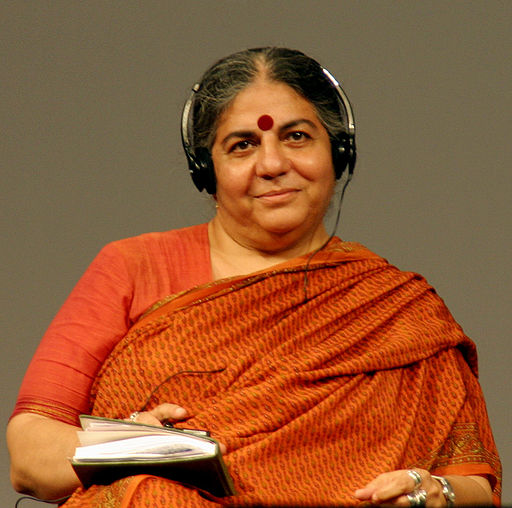
Vandaana Shiva was involved in the Chipko Movement and following the event she helped to substantialize the ecofeminist movement. She was a theoretical physicist, and after the Chipko movement became involved in environmental work and ecofeminism, and writing a book in 1988 titled “Staying Alive: Women, Ecology and Development.” Shiva’s career is lined with environmental activism — including forming organizations in India to minimize ecological threats as well as leading the Research Foundation for Science, Technology and Ecology (RFSTE).
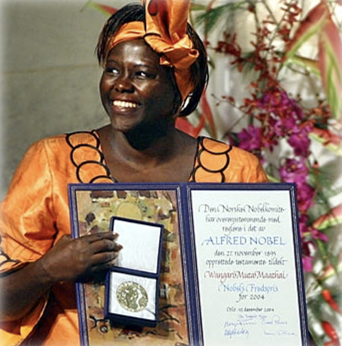
A few years after the Chipko Movement in India, another ecofeminist movement began in Kenya known as The Green Belt Movement. It began as a local community tree planting effort founded by Wangari Maathai and led by a group of women. Its tree planting efforts have combated deforestation and soil erosion, as well as stored rainwater and provided fuel. It empowered rural women to fight for environmental conservation and improve their livelihoods. Both the Chipko Movement and The Green Belt Movement realize the importance of environmental conservation in the pursuit of equitable economic development. Wangaari Maathai’s success in fostering grassroots action through the Green Belt Movement gave her worldwide recognition and awarded her the Nobel Peace Prize in 2004. She made history as the first African woman and the first environmentalist to win the Nobel Peace Prize. She was also the first woman in East and Central Africa to earn a doctorate degree.
There have been many other movements, such as the Love Canal Movement of 1978 in which a community was suffering chronic illness due to being built on top of toxic waste. Lois Gibbs led her community in that movement to protest in order to get answers and compensation. There was also the Greenham Common protest in Berkshire, England organized by the group “Women for Life on Earth,” which connected the anti-nuclear movement to feminist and environmental issues. Countless other movements across the world have combined the forces of feminism and environmentalism in order to establish a more equitable future for both.
Modern Day Implications
It’s not a coincidence that women’s rights are being threatened at the same time that more mass ecological destruction is being proposed. We have seen in recent years attacks that have been made to rollback women’s rights via retraction of reproductive rights, public participation and political representation, as well as legal and social protection. Additionally, the general discourse surrounding women from the current leaders of the U.S. are appalling and accepted by far too much of the public. We have also seen the attacks on the environment as leaders push for policies that will increase deforestation, pollution and further the effects of climate change. It’s also vital not to ignore the fact that many other marginalized groups defined by race, class, and/or gender are being targeted in policy and by actions of the government at this time as well. By recognizing the intersections between climate change and social issues we get down to the root cause of each and are better able to find solutions to all.
In the case of gender inequality, empowering and elevating women and girls is strongly linked to reduced carbon emissions. The 2020 Drawdown Review listed the education and empowerment of girls and young women as the second most impactful step in reducing carbon emissions. When women are empowered through access to education (creating career opportunity) and family planning resources, they have more control over the structure of their lives. Family planning allows them to determine when and how many children (if any) they want to have. Women tend to have fewer — and healthier — children with access to these resources. A slower population growth means that less people are relying on the earth and using its resources and, therefore, relieves stress on the ecosystem and reduces carbon emissions.
The representation of women in policymaking is also important for the future of our planet. Women and marginalized groups are disproportionately affected by climate change, so when women are given representation in politics, they represent these environmental issues that are at the forefront of their own lived experiences. According to a 2015 policy brief that recorded how women in El Salvador, Chile and Vietnam participated in local and national environmental policymaking, women tend to prioritize the preservation of natural resources and are in better positions to apply local knowledge to their responses.
Women are disproportionately affected by climate change than men, in part due to the fact that traditional roles have put them in a position to be more reliant on nature. As outlined by the India Climate Dialogue, impoverished women are 14 times more likely to die from a climate-related disaster than men since they are generally the primary caretakers and unable to leave those vulnerable areas as easily as men. These traditional frameworks make women more vulnerable to climate disasters, as well as prevent them from gaining political representation, in effect maintaining the hierarchy. The issue is with the institutionalized subordination that puts both women and ecological destruction on the backburner. Neither has enough representation and neither is at the same level of hierarchical standing as men within a patriarchal system. Ecofeminism helps us to understand these dualisms, seeing how they operate within a patriarchal sphere and work to dismantle them in the name of feminism and environmentalism alike.
In the Community
In implementing ecofeminist ideas to our own lives within the Wasatch area, we can engage in community initiatives and local politics. We can also discuss the intersectionality of gender inequality and ecological destruction with friends and family, to help teach more people about these connections. Learning about both of these realms within our community – local environmental issues and social justice issues – can help us be more informed citizens. Studying ecofeminism helps us to see the underlying harms of a patriarchal system that often goes unnoticed in our day-to-day life. When we become aware of these connections, we can more easily deconstruct these paradigms, starting first with our own consciousness. As we recognize these hierarchies that are harmful to both women and nature, we can utilize ecofeminist principles to pave a way for the future in finding new solutions to both the climate crisis and gender inequality.
For further reading on the topic:
- Feminism and the Mastery of Nature by Val Plumwood
- Staying Alive: Women, Ecology, and Development by Vandana Shiva
- Ecofeminism by Maria Mies & Vandana Shiva
- How Women Can Save The Planet by Anne Karpf