
In our current political and social climates, it is challenging to see areas of life where people are working together. Divisive language online and in the news can make it seem as though competing cultural values mean that no good can come to fruition in those spaces. So, dear reader, I invite you to join me as I share two instances of collaboration I’ve found, right here in our Utah backyards.
Collaboration One: Relocation Instead of Hunting
North American beavers – a keystone species and historical fashion statement – are small rodents with large impacts. Their mountain dams create lush wetlands with downstream benefits, including allowing slowed water to absorb into natural aquifers, serving as natural firebreaks in containing wildfires and dramatically increasing wildlife visitation and overall ecosystem health. Plus, thanks to their natural instincts, they are a fraction of the cost of human-made solutions to increase river health. However, beavers do not know these things. They don’t realize that those benefits are best served in our mountains, deserts and undeveloped wilderness, so they go wherever they please. Despite severe population decreases in the 19th-century fur trade – and continued lack of wetland areas – beavers have made astonishing comebacks (though likely not because of the 1948 effort to parachute them into rural Idaho areas). According to the IUCN Red List, they are a species of least concern, with an approximate recovery score of 83%. Meaning, there are plenty of beavers around, and since they aren’t all off making wilderness wetlands, they are inevitably running into and making conflict with people.
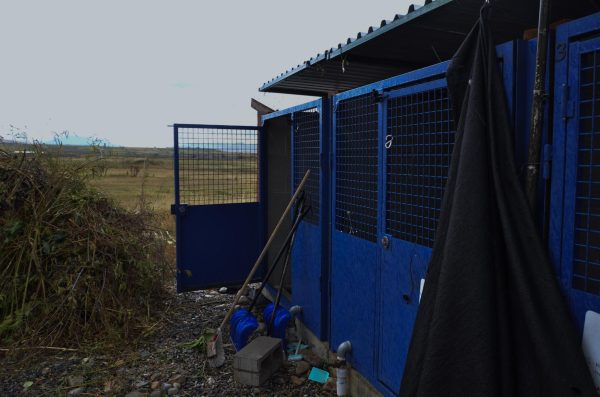 It was a stormy day in October when I visited Utah State University’s Beaver Ecology and Relocation Collaborative – and the temporary beaver housing called the Beaver Bunkhouse. Over an hour outside of the Salt Lake Valley, and nestled a stone’s throw from the south Logan suburbs, sat an open field of brown grass and a couple of distant gray buildings. I followed just behind a white pick-up truck down a dirt road as my windshield wipers ran continuously. We crested a small hill, and I spotted a small, cement-brick, boxy building with blue doors, a metal roof and an even smaller wooden shed next to it. If I hadn’t known this place housed wild beavers, it never would have crossed my mind. Only the rainy air put me in the mood to think of them; only the wet ground and plants made the area seem right. As soon as I arrived, Becky Yeager, the collaborative’s Volunteer Coordinator, had me glove up to help feed beavers and clean enclosures. Volunteers like me assist in caring for nuisance beavers before their relocation, and I was able to help and observe the beavers up close.
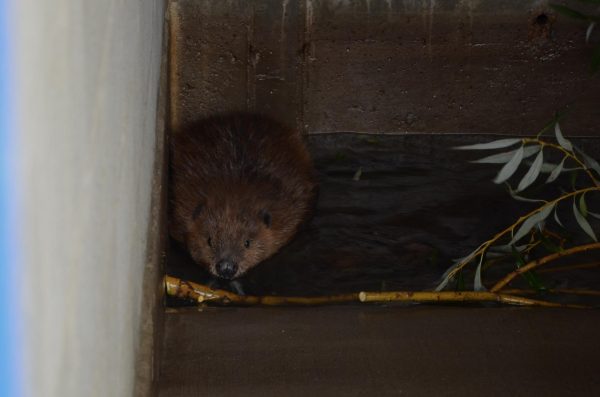
Beavers are, one might say, family-centered critters. They have strong bonds, and families that stopover in the Bunkhouse are kept together in the same enclosure. Back in October, there were five beavers at the Bunkhouse, only two of which were related – a father and son. Other beavers housed there included a girl whose tail had been injured in a trap and who’d likely be there longer than the 72-hour quarantine. There was also a boy named Aslan, named after C.S. Lewis’ famous lion because of his unusually light-colored fur. All of them were fed the typical beaver diet of aspen, dogwood, willow and cottonwood – plus the occasional treat of apricots and pumpkin. Each “hotel room” was outfitted with a hideaway made from half of a repurposed metal barrel, from which the floor sloped downward to create a basin that was filled with water. After we finished with the beavers, Nate Norman, the current lead biologist of the Beaver Ecology Center, walked me over to the wooden shed, which served as the beaver check-in area. There, the team utilizes a “beaver bag” to determine the sex of the beaver, draw blood and implant a tail tag – an electronic chip similar to a dog’s microchip. This work provides unique research opportunities to understand beaver behavior, collect DNA from their chew sticks, collect informative nematodes and track the beavers after release. More than this, though, the work of the Beaver Ecology and Relocation Collaborative offers an alternative to lethal trapping when dealing with nuisance beavers. The fur trade is no longer a threat, but conflicts between beavers and humans still happen, and while permits are available for trapping, beavers are a protected species. By providing a clear opportunity to relocate nuisance beavers – to keep them from destroying the suburban backyards our culture takes such pride in – we’re able to keep protecting beavers, foster beaver-human peace and send them to areas that need their ecological benefits again.
Collaboration Two: Hunting with Good Reason
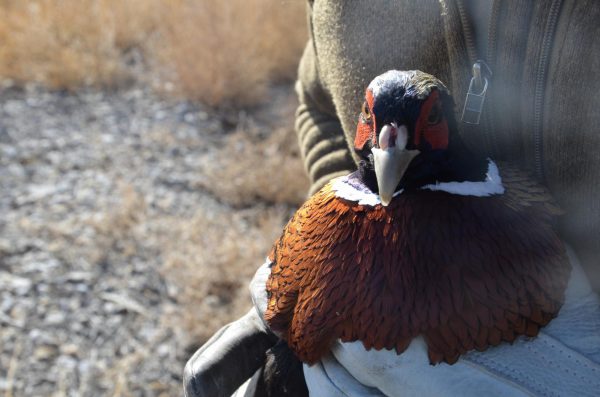
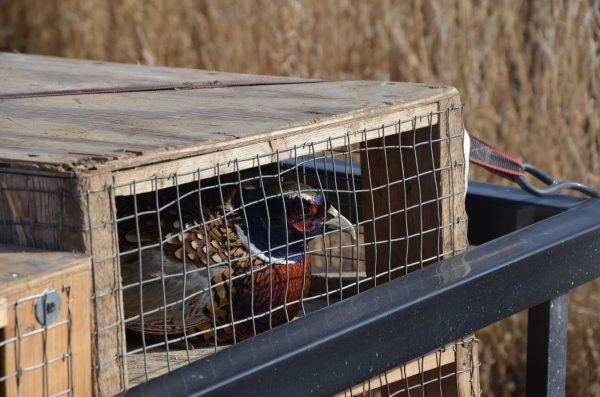 A month later, on a cold November morning, I hopped into the cab of a Utah Division of Wildlife Resources (DWR) truck that was pulling a trailer with crates full of … pheasants. The birds had shimmering brown feathers and incredible jewel-toned heads. We drove around the south side of Utah Lake, stopping at three different areas each with large, brushy fields. I helped carry crates deeper into the brush, not too far from the truck and trailer. Then, one crate at a time, I tipped the crates upward, so the one-way metal door swung open, and as I fought against a flurry of stressed, misunderstanding wings, I grabbed a pheasant. I’ve found that birds tend to always be bigger than you expect, while far lighter than you expect. Holding him firmly around the wings, the pheasant calmed immediately. He still didn’t understand, but he would. Then in one movement, as the DWR biologist instructed, I threw the bird into the air. It was enough to give the pheasant enough extra height, and he flapped quickly away over the trees. The pheasant would likely be dead soon – I could already see hunters driving up to park near our truck – but for that moment, he flew free.
Ring-necked pheasants are colorful game birds, native to Asia and parts of Europe. They were introduced into Utah around the turn of the 20th century, quickly adapted to the state’s shortgrass prairie ecosystems and have since proliferated and become a hunting staple. However, due to city development and habitat loss, current pheasant populations have dwindled. Releasing roosters can seem like a perfect solution to this population problem, but it turns out it’s not that simple. The pheasants I helped release were pen-raised and bought from 4-Mile Hunting Club, meaning they were not made for surviving in the wild. This has put the DWR at odds with pheasant conservation groups such as Pheasants Forever (a fact which was only exacerbated by a 2022 miscommunication that led to the deaths of hundreds of pheasant chicks). However, the Utah DWR does not release the roosters each hunting season to increase pheasant populations, but to provide more hunting opportunities for Utah hunters – which has its own avenue for collaboration with the public.
There are two important sides to this interaction. First, hunting culture is prominent in Utah, as it is in many other states. Not only that, but hunting has been important in regulating (over-successful) deer populations – it’s not some big bad environmental evil that we should get rid of to fix unhealthy biodiversity. Second, the Utah DWR is very invested in conserving wildlife habitats and enhancing wildlife populations. This includes Utah’s short-grass prairies and sagebrush ecosystems, which are highly threatened and critical to native wildlife such as hawks and the pronghorn antelope. By providing an opportunity for recreational hunting, hunters can become additional stakeholders in preserving this important habitat in a way that doesn’t further deplete the pheasant population. Not only that, but due to the Pittman-Robertson Act (1937) and Dingell-Johnson Act (1950), the only guaranteed funding for national wildlife conservation comes from excise tax on hunting and fishing supplies.
Better Together
Whether it’s providing non-lethal alternatives to a culture unfavorable to certain wildlife or fostering a community in a way that brings them in as fellow stakeholders, collaboration can be found in many corners of environmental conservation. Collaboration may not be perfect, and it may not be conventional, but through working together it can make a change – change that can impact things from little brown beavers hidden in rivers to the iridescent pheasants flying above the trees, and everything in between.