

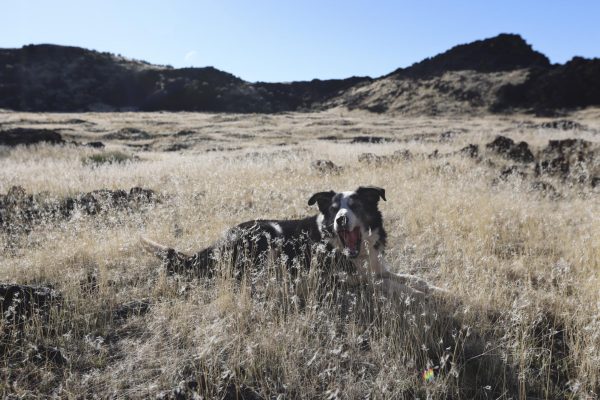
 When the subject of volcanoes is brought up, most people conjure up images of red-hot lava spurting out of mountain tops and ash clouding the air. Places like Indonesia and Hawaii come to mind for their prolific hot spots of volcanic activity, as well as ancient eruptions like Pompeii. One place that doesn’t typically come to mind for most people is the central Utah desert, but you’d be wrong to think that this area doesn’t carry its own history of volcanic activity. While there may not be any active volcanoes in this area at the moment, they were certainly there once upon a time, and they left some amazing aftermath.
This desert area in Millard County is part of what is known as the Black Rock Desert Volcanic Field, which stretches from northern Arizona all the way up into central Utah. This field was a hot spot for volcanic activity millions of years ago, and its remnants are still visible today, earning its name for the flows of black rock frozen in a flowing motion across the desert.
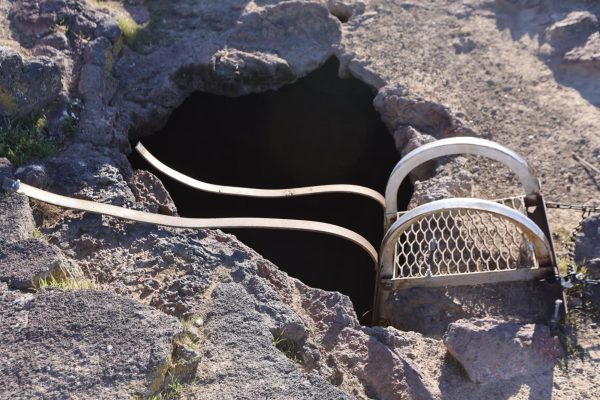
One of the most notable features left behind from these volcanoes are the lava tubes. This is a series of tunnel systems caused by veins of lava at the base of the Tabernacle Hill cinder cone. The outer edges of these veins cooled to create a shell of hardened lava rock, and as the subterranean lava drained, hollow tubes were left behind.
The Lava Tubes
Now, millions of years into the future, these caves are available for exploration. A few miles west of Meadow, Utah, these tubes are easily accessible to the general public. Driving out there, you can see miles and miles of black rock against the white, dusty ground all below an expansive sky of clear blue. Once you reach the Tabernacle Hill (the middle point where the tubes emanate out from), you can begin exploring. There are caves and crags and crevices scattered all over.
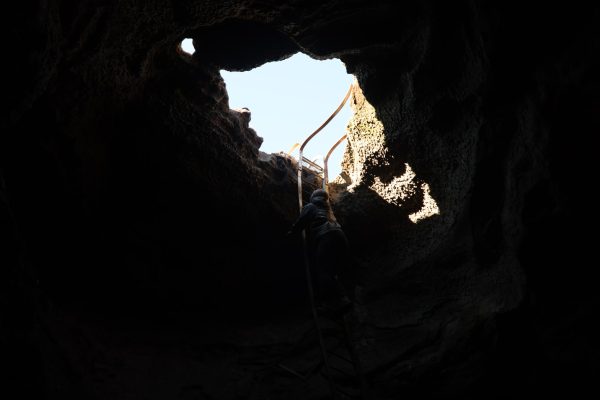
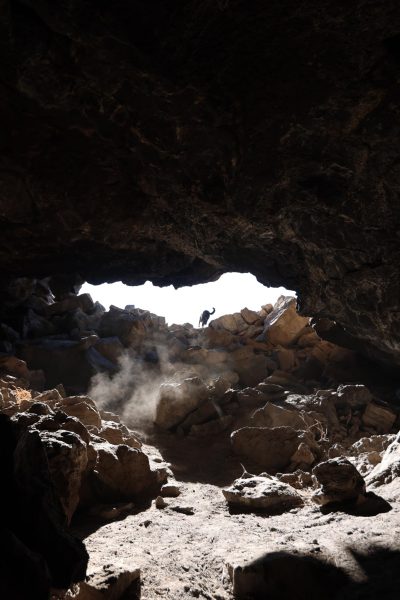 One feature that is particularly spectacular is called the Pigeon Hole. If you take the main road past Tabernacle Hill heading southwest, you’ll reach what looks to be just an ominous black hole in the ground. But do not be deceived, there is more than meets the eye; this hole opens up into a large cavern of lava rock. The seemingly scary well of darkness has a metal ladder descending into its depths. The ladder is probably between 20 to 30 feet and reaches nearly all the way to the bottom of the cave (a word to the wise: the last few feet change from solid metal to a chain ladder, so if you’re thinking of taking the trip down to the bottom, make sure you are confident in your ability to climb back up).
The name “Pigeon Hole” is well deserved, and anyone who ventures down will learn that soon enough. Flocks of pigeons roost in the protection of this hole in the ground, and as you’re climbing down the ladder, these birds will fly right next to you as they exit the cave. Down on the bottom, there are pigeons nesting and clinging onto the rock in the darker parts of the cave, and any steps made too close to the edges will send them flying through the air.
There is something magical about this Black Rock Desert. It is an incredible natural phenomenon that transports visitors back into ancient times, experiencing central Utah as an active lava field. The history of the area dates back millions of years, and when you’re crawling through the tubes of lava below the earth, you feel it all around you. There is so much ground to explore — above and below — that you could spend days wandering while only scratching the surface. While Utah doesn’t seem like it would be a hot spot for volcanic activity, it certainly has its moment, and the lava tubes prove that to be true.