


Forget ghosts, the only thing flying under the full moon in the months after Halloween will be plastic bags and candy wrappers. The holiday, like Christmas coming up next, was initially based on religious festivals and spirits, but has now transformed into costume parties, cavities and overconsumption.
Consumerism’s effects on Halloween have led to drastic environmental impacts. Candy wrappers, Amazon bags, cheap costume production and decorations cause frightening amounts of pollution before, on and after the scariest night of the year, and according to the National Retail Federation, “Halloween spending is expected to reach a record $13.1 billion this year.” Climate change and pollution are reaching critical levels, so understanding our effect on the environment and how to reduce waste is essential.
Zombie Plastics
The Environmental Law and Policy Clinic at Duke University conducted a study on campuses and in surrounding neighborhoods. They found that candy wrappers and plastic film made up the most waste. “Plastic litter can persist in the environment for centuries after it is
discarded,” said Michelle Nowlin, the co-director of the clinic. Additionally, “about 83% of Halloween costumes use non-recyclable oil-based plastics,” according to ABC News, “which means they were likely destined for the landfill from their conception.” Most Halloween
costumes from Amazon, Shein or Spirit Halloween use these oil-based, non-biodegradable materials like polyester, nylon, acrylic and Spandex. “That’s like dressing up in plastic bags,” said Lexy Silverstein, a sustainable fashion advocate.
As well as ending up in landfills, the costume materials and chemicals in cheap makeup and face paint can drain into rivers and lakes. These toxins can harm ecosystems and pollute the water for nearby cities. Not only does this harm the environment, but the process of making those ultimately deadly, cheap costumes is causing an increase in greenhouse gases. This isn’t to say Halloween and other product-heavy holidays should be canceled. Instead of shaming trick-or-treaters and telling friends not to dress up, try having an environmentally friendly Halloween instead.
Lessening Your Impact
About 35 million Halloween costumes are thrown away each year in the U.S. These Spiderman masks and witch hats will be haunting landfills for centuries unless Halloween overconsumption is mitigated. Creating costumes and decorations with cardboard and fabric is a
great way to lessen this impact. If there isn’t time to create a new costume, going to local thrift shops or using everyday clothes to dress as characters can be better for the environment and less expensive.
Costumes and decorations aren’t the only things that can become more environmentally friendly. The plastic waste from the wrappers of $3.5 billion of candy can be reduced by buying candy in recyclable packaging. Candies that come in 100% aluminum foil or cardboard — like Hershey’s Kisses or Milk Duds — are good options, and a strategy that can carry on into the winter holidays. Additionally, according to Keep America Beautiful, a community improvement nonprofit, buying candy in bulk lessens the number of individual wrappers going into landfills.
Till Next Halloween
After Halloween, instead of throwing away costumes and decorations, consider donating or reusing them next year. If your costume is thrifted, you can even incorporate it into your daily wardrobe. An example of this is U of U student, Paris Powers. “This year I tried to be more environmentally aware of the things that I was buying for Halloween,” said Powers, “like finding clothes in my own closet for costumes… rather than buying them at the store or Amazon.” (573) Acknowledging the wasteful aspects of holidays, not just Halloween, doesn’t have to be pessimistic. Discussing the impacts of waste on the environment can lead to awareness and new ways to create a more sustainable future.
A White and Red but Mostly Green Christmas
The best present you can give during the holiday season is wrapped in green. Or not wrapped at all.
White Christmases have become scarce over the last couple of years. As temperatures continue to rise, the future of the holiday season and winter traditions is being questioned. Not only will winter sports like skiing, snowboarding and ice skating be affected by this temperature shift, but the prices of holiday commodities will also get more expensive.
According to the National Oceanic and Atmospheric Administration, “the chances of having at least one inch of snow on Christmas are gradually decreasing across the Southern United States, and this trend is slowly moving north.” Climate change isn’t just a faraway thought; its effects are becoming drastically clear. So, especially in Utah, where winter sports are a part of the culture, creating a difference in how we celebrate the holidays will be better for everyone, including the environment. While the concept of lessening climate change must be performed on a global level, there are still ways to have a better impact on the environment at home. Especially around the holidays.
of this waste includes wrapping paper, food, shopping bags, bows, and ribbons, etc. For being a season about giving, most stuff is given to the trash. To steady this rate, coming up with ideas on how to have a practical and clean holiday is paramount.
The Gift That Keeps on Giving
For your next white elephant or holiday gift exchange, consider buying a durable or reusable item. Gifts that come in recyclable packaging, are homemade, or are practical. Don’t buy gifts that aren’t going to be used. Yes, this means those gag gifts that just end up in the back of a closet or re-gifted next year. Not only will it be better for the environment, but it will also be a better gift to receive.
It’s not just the gift that should be given more thought, but also its holiday wrapping paper. It was reported that “8,000 tons of wrapping paper are used during the holidays each year, equating to roughly 50,000 trees,” according to Clean Air Partnership, a nonprofit environmental organization. Instead of tearing away at the colored paper like a cat clawing at the Christmas
tree, consider saving it for next year. Stanford reported that if every American family wrapped three presents in recycled paper, like brown paper bags, old magazines, or reused wrapping paper from the year before, they would save enough paper to cover 45,000 football fields.
Saving Turkeys
The next biggest factor of the holiday season is food. From Clean Air Partnerships, food typically travels around 1,500 miles before it reaches the plate. They suggest that hosts for the holidays consider locally grown or organic foods.
Kate White, senior associate dean of equity, diversity, inclusion, and sustainability at the University of British Columbia’s Sauder School of Business, said that the meal with the highest carbon footprint is beef, followed by poultry, fish, and vegetarian meals. While it may not be
possible to adjust an entire meal to be 100% organic, replacing certain parts of the menu can create a unique holiday experience.
After dinner, make sure to save leftovers for the next few days. Use reusable glass dishes, reusable dishware, and napkins. Look up meals that can be made with leftover ingredients and food. Casseroles are a great dinner idea for the days after Thanksgiving, because they can use stuffing, gravy, and potatoes that would otherwise go bad.

Plane or Santa’s Sleigh?
Possibly the biggest part of the holidays is travel. White said that transportation is the No. 1 source of carbon dioxide emissions during the holidays, and it’s only increasing. In 2022, over 50% of Americans planned to travel over the holiday season. Cancelling a family vacation probably isn’t going to happen, but there are still ways to make your vacations more environmentally friendly. For instance, consider which method of transportation will be the most effective for you. Driving has less of an impact than air travel, according to White. However, taking the bus or the train is even better. When you reach your destination, limit transportation. Consider a hotel within walking distance of your activities or use public transit.
“If each family in the U.S. reduced gas consumption by 1 gallon, or opted to drive 20 miles less, it could lead to 1 million tons of reduced greenhouse gas emissions.”
Season of Giving
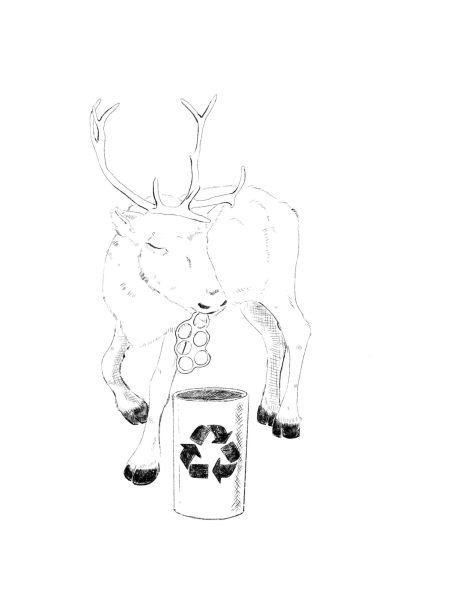
By implementing these suggestions and taking accountability for the environmental effects during the holidays, they can become a cleaner, more enjoyable season. Recycle and reuse but also remember it’s called the season of giving for a reason. Consider donating to your local charities, food banks, and homeless shelters. Something that never goes to waste is supporting your community and spreading kindness.
“All of this isn’t really to make people feel guilty, but maybe make people just consider different options,” White said. Just as acknowledging the environmental impacts of Halloween isn’t meant to make you scared, acknowledging how holiday traditions are affecting the environment shouldn’t turn you into the Grinch. Don’t be afraid to suggest sustainable alternatives to the holiday fun; it will make a difference.