
I’d like to start with a quick disclaimer for the reader: this document is wrought with mushy emotions and shallow self-reflection; read at your own risk.
A Boy and a Canyon
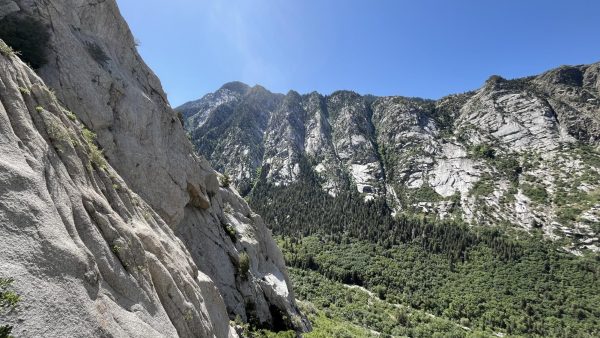
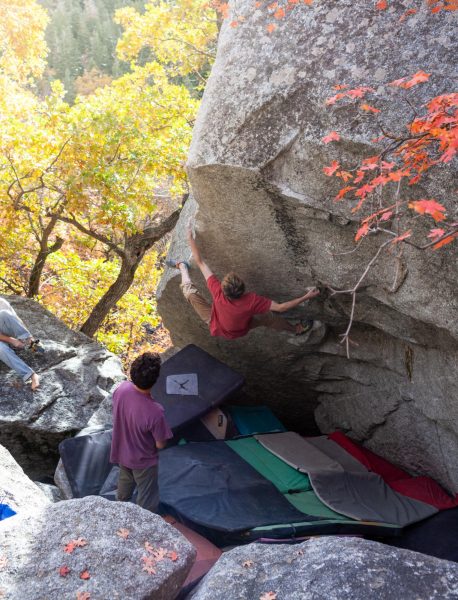 I remember my first day in Little Cottonwood Canyon. It was a toasty April Saturday near the end of my second freshman semester. Sun dripped through the newly grown leaves, casting shadows, deckled and dancing, on the dirt and rock. A crisp breeze traveled down the canyon, swirling around the trees and around our feet, a welcome reminder of the snowy ecstasy that was the winter of 2023. It was the perfect day for spreading bare feet through the soil and drowning in the sun and birdsong. But my two friends and I weren’t there to enjoy ourselves; we were there to climb rocks.
At this time, the only experience I had with outdoor bouldering was one or two adventures down to southern Utah, an ego-obliterating week in Red Rock National Conservation Area and countless hours spent watching climbing films instead of doing homework. None of this prepared me for the unique technical challenge that Little Cottonwood’s granite offers. My status as a gumby (a climbing newbie) was rapidly made apparent to me.
I spent that first day in the Canyon flailing on a V2, screwing around on a chest-high mound of breadcrumb-expelling choss and topping it all off by attempting (and failing) to do any moves on a semi-classic V5 called “Tom’s Problem.” I didn’t get to the top of a single boulder. The relative success I found in the Summit, the gym on the U’s campus, didn’t translate to real rock (who would’ve guessed?). While I knew there were levels to this whole climbing thing, this experience showed me in graphic detail just how much I had to learn.
After a summer back home in Tennessee, I returned with passion in my heart and fire under my ass. I was going to have a good fall season. As leaves began to brown and temperatures began to drop, getting outside was the only thing I could think about. Luckily for me, one of the wonders of Little Cottonwood is how incredibly accessible it is. I spent more and more time in the Canyon, giving me more and more opportunities to fail. But as I failed, I (at a snail’s pace) began to uncover the intricacies of the rock. I started relying more on my feet, and getting better at using the slimy, miniscule protrusions some call footholds that define lower canyon climbing. I could feel my technique improving. Little Cottonwood’s granite became my mentor, sculpting me into the climber I am today.
I didn’t find much success that fall season, only getting on top of a handful of boulders, but Little Cottonwood kept calling me back. Eventually, I found myself improving. While “getting better” isn’t something I quite understand, I was becoming a more intentional, thoughtful climber.
Jumping to the present, I have found myself on top of a few rocks that I’m incredibly proud of. Somewhere in the ballpark of two years after that first day in the Canyon, I sent Euro Roof, a bona fide canyon classic that gets V10. A month or two later, I wrestled my way up Neolithic, a newer climb, and my hardest send up to that point. Climbing has taken me to areas around the country I never would have given a second thought, and it has given me some of my closest friends. That 19-year-old struggling to pull his ass off the ground on that toasty April Saturday would be shocked, pleasantly or otherwise.
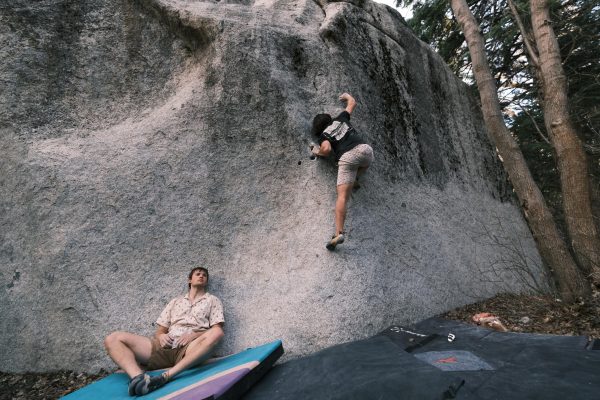
I write this not to shamelessly boast about my own progression, but to attempt to capture the transformative nature of Little Cottonwood Canyon. My experience is not unique. In one way or another, Little Cottonwood has affected everyone lucky enough to recreate within it. Whether it has made you a better skier, given you unforgettable memories or simply made you appreciate the outdoors a little more, Little Cottonwood has indelibly woven itself into the continuity of your life. On a larger scale, it helps build the foundation of outdoor culture in the Wasatch Front.
A Spark for Advocacy
And it has inspired countless environmental advocates, including yours truly. Before I ever stepped foot into Little Cottonwood Canyon, I heard about the gondola proposal and became involved in the discourse surrounding it. In doing research into the issue and becoming involved in some anti-gondola advocacy, I found a passion I didn’t know I had. After drifting from one major to another, I decided environmental advocacy was something I could pursue, both academically and professionally. My entire trajectory shifted, and the forking paths of my future became more focused. It’s no wonder that my imminent graduation has inspired me to look back on the Canyon with fondness; it’s the reason I’m here.
Many local environmental groups are inspired by the beauty of Little Cottonwood Canyon. To name a few: Save Our Canyons, Friends of Alta, Canyon Guard and Friends of Little Cottonwood Canyon. Other groups, like the Salt Lake Climber’s Alliance, contribute to the protection of Little Cottonwood through trail cleanup and maintenance events, as well as advocating for low-impact climbing practices. Student groups, like Students for the Wasatch, are also involved in Little Cottonwood advocacy, allowing the next generation of environmentalists to cut their teeth by becoming involved in real issues. You’ve likely been involved in, or at least heard of, one or more of these groups. They are doing their part to ensure the Canyon is a place where us humans, as well as our nonhuman friends, can thrive responsibly.
Little Cottonwood Legacy
Inspiring hikers, climbers, skiers, environmentalists, artists and more, Little Cottonwood Canyon is a special place; it’s a well of good and a vanguard of biodiversity. Whether you are an avid outdoorsperson or going outside for the very first time, an amateur or a pro, a gumby or a crusher, a human or a bug, there is something Little Cottonwood has to offer. It is a place for growth, play, advocacy and dreaming. It is a mentor and a dear friend.
This semester, I graduate. I’ll move back home as I continue to hunt for jobs, and my path will diverge from the trails found in the Canyon. But it will never truly be far. In writing for Wasatch Magazine, I have found myself looking into Little Cottonwood’s past. It is far more ancient than I can fathom. I think back to the members of the Alpenbock Climbing Club, who explored the Canyon’s rock many decades ago, and I am reminded that Little Cottonwood ties us to generations past, as well as those to come. Mere geographical distance is chump change. Little Cottonwood is a part of me as much as I am a part of it. It really is something special.
Thank you Little Cottonwood. I hope I find myself running through your trees again.