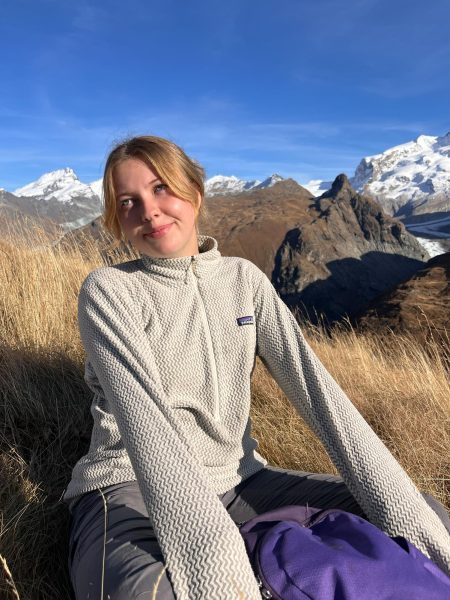


Imagine the Annapurna mountain massif, of the north-central Nepali Himalayas, as an enormous living breathing beast. Its scaly snow-dusted spines poking out at each peak, threatening to scrape through the fragility of soft, windswept clouds hovering in the atmosphere. Its front claws protrude at Annapurna Dakshin and rear at Machapuchare, attempting to lunge itself forward, halted by the moat that surrounds it on the west side—Kali Ganduki Gorge, the deepest gorge in the world. The Marshyangdi River drapes itself along the side of the creature as a coat following down to its serpent tail. Glaciers hug to its abdomen in icy sheaths of protection as hard scales are surrounded by pillowy soft snow-white flesh that is vulnerable to the elements. Its movement is illusive and incomprehensible to the human eye, a timeline over millions of years as its great body surges with the shuffling of tectonic plates below. In human time, only one centimeter of the rising in its breathing chest occurs in a lap around the sun.
Metasedimentary rocks coat the skin of the creature in a sporadic array of color and texture: the limestone a porous and crumbly cream, sandstone a burnt orangey hue and layered, shale a grey millionth tiered cake, gneiss an interchanging display of black and white shine. Each layer reveals the process of the rock’s birth—the grinding of tectonic plates exposing the minerals in sedimentary rocks to immense pressure and heat, melding the sediment together as a newly formed structure, as if slicing deli meat and cementing them together in a bake. Sparse tufts of foliage spurt out at the lower elevations as trees lining the imprint of the dragon; simal trees with fiery red blossoms across spindly, longing cacao-colored branches, and rhododendrons in their spherical bloom of blush pink to deep red are sat upon a bed of oval, green, waxy leaves. Higher up, these sputter out into grasses and mosses of wheat yellow and a muted green, as if the color itself is hiding from the beast’s spines and the harsh cold it brings with it.
The dragon is nearly rid of fleas, but a few commensal species remain. A snow leopard lurks on the crevices of rocks, illusive and unseen as a hidden traveler on the beast’s back. A musk deer settles in for rest as the light of day returns and its nocturnal life comes to an end until the sun rises from the east again. Himalayan Tahr scale unthinkable cliffs as they meander the rock’s edges, a thick glossy long-haired coat and curling horns to protect them from the elements and few predators that lurk. Fluffs of auburn fur shyly cling to trees—the red panda in its uneasy home. Yaks graze on grasses, distributed between the few huts that boast their conquering presence upon the spines. We can see the delicate bodies of the species that inhabit these dwellings. Too frail and bare to handle the elements on their own, they bundle themselves in layers of nylon and polyester, wool and cotton. Below the majestic Machapuchare, on Mardi Himal, a gathering of these Homo sapiens engage in some celebratory ritual, hands thrown up to the sky, mouths whooping a chorus of excited shouts.
Here I find myself. Atop the dragon. The thin air seeps into my lungs blessing me with the gift of life as I fling myself forward, legs running too slow for the momentum of my upper body and I face plant ungracefully into the plush white powder of ice surrounding me on all sides. My first thought is, “oh god, I hope no one saw that”. Akshay trudges past me chuckling as I whip up to standing and can’t help but hysterically laugh with him as I push myself to keep running forward.
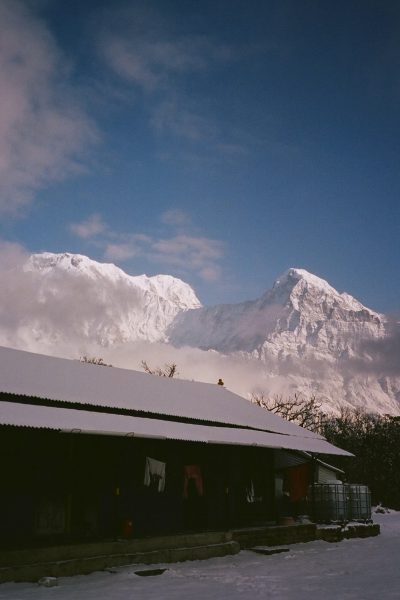
No hesitation in my step, I pick up the pace—at which I am practically jumping hurdles—over knee deep snow from one plod to the next. Khashing is leading the race, in first place, his lungs accustomed to the altitude having been born and raised in Nepal. Kiran and Alex follow, heading toward the race’s endpoint at a little wooden hut—a teahouse that is closed for the season, boarded up with no bukhari lit inside, and no smoke rising from the chimney. It’s unlike the teahouse the others in the group are gathered around, sipping hot soup behind us.
To my right, Machapuchare glistens with the flecks of a dusting of a million snowflakes, its pointed profile interspersed with rock peeking through where the vertical relief is too much for snow to even stick. The double summit’s tight pointy peaks stick out from one another in opposite directions resembling that of a fish tail, after which it is named (Machapuchare meaning “fish’s tail” in Nepalese). Hiunchuli resides to my left, not quite as striking as Machapuchare, but a sloping majesty holding a sweet cradle that could be the hammock of the gods. Wisps of powder levitate in the space above Hiunchuli, caught in the sun’s intensifying morning glow and soft breathy wind.
A feeling I’d been chasing is clasped fully in the grasp of my reality—contentment, adventure, thrill. But more than that. The feeling of complete and utter alignment, entrenched in the clarity that nature bears. The culmination of decisions to bring me to this exact place. The intuition tells me that here is where my life becomes my own. I could go to the beginning, but instead, I will go to the start of this day.
The world is still dark, only the glow of the moon (a waxing gibbous one day away from full) and twinkling stars reflect off the snow that surrounds our teahouse lodging. It is the early morning of February 23rd, 2024, I don’t even care to know what day of the week it is. In the mountains, time is a relative thing—experience is the measure of time. I’m nestled into my 0º sleeping bag, nose frigid in the air, toes bundled in socks that still don’t seem to keep the cold out. Sleep is interwoven with bouts of being awoken from the cold: any part of your body not thoroughly layered is sure to be apparent around midnight, when the chill runs deep into your bones. By the 5th night of the trek, I have the technique to stay warm through the night mostly figured out: a merino wool base layer, followed by a fleece jacket and fleece pants, a puffer jacket, 2 pairs of socks layered on top of one another, a beanie, and sometimes mittens. We are at our highest altitude lodging and it is winter still—cold cuts through almost everything here. Using the toilet is like exposing your bum to an ice bath. The grease in my hair has begun to build up after days with no shower. I am sure we all stink like hell. Our backpacking journey has included sweat interspersed with freezing, a constant struggle to find the medium between overheating with the exertion of steep inclines and freezing in place like a relic stuck in ice. At least if we do stink none of us can smell it—we are all equally nose blind.
4:00 am ticks onto our watches, setting off alarms, beeping most of us awake. Others require a firm shove from a roommate, croaking in disdain. Extracting yourself from the accumulated heat of the insulated bag is the most excruciating part of waking up, akin to siblings ripping off the blanket while you nap on the couch. It feels primally wrong to be awoken from hibernation this way.
I throw on hiking pants and a puffer jacket over my thermals and head to the communal hut, following the path that connects it to my shared room, saying hi to the moon and our first glimpse of the silhouette of Machapuchare on the way. The night before we ate our meal of dahl bhat here, followed by hours of playing card games and chatting around the wood burning stove, relishing in the heat and laying out hiking boots to dry after days of trekking through snow. I find my boots among the other various hiking shoes strewn around the heater. Others in the group are gathering around a table with cookies and dudh chia (milk tea) for an early morning breakfast snack before our departure. After lacing up my toasty shoes, I grab a mug and cup my hands around it, heating my fingers while sipping on the sweet black tea. Conversation is sparse. We are yet to warm up to the day that has yet to really begin, the sun still feeling shy at this hour of the morning. Except for our guide Dawa—he is ready to start the hike and urging us to get going.
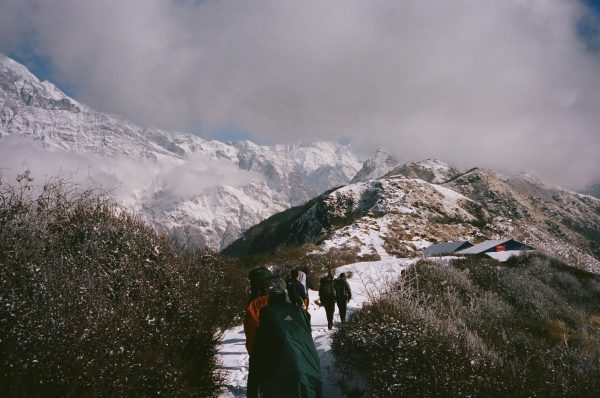
Headlamps illuminate the path ahead in little rays of information. An indentation of a scooped snow trail leads up an otherwise inconspicuous mountain ridge. There is a sacredness in the air. A mountain spirit welcoming us into this other world that I have yet to ever venture. Or perhaps it’s the spirit of a passed loved one in that wind, on yet another adventure with me. My fingers are cold, even though my body is working hard to propel me up this steep incline, microspikes dig into the snow keeping me from sliding all the way back to Mardi Himal base camp.
Our 70-liter bags remain at camp while we bring with us only a daypack—mine with water, a granola bar, and cameras jangling around inside. My lungs are thankful for this as I feel the air tugging at them, lacking its usual supply of oxygen. We resemble a line of zombies inching closer to whatever invisible force is calling us to its command—mute with grumbles interspersed every so often, eyes glazed over and monotonously placing one foot in front of the other.
Then the sun begins to rise over the east mountain ridge and colors surround us like a symphony. Slowly at first, with just a line at the horizon of a glowing reddish orange, signaling the sun’s fiery approach. Then it disperses across the sky into pastel hues of light violets and dusty pinks. The vast world of snow and ice, barely visible before now, is overwhelming in its magnitude. First Hiunchuli and Annapurna South are embraced by the golden rays of early morning. The eastern edge of Machapuchare’s fishtail catches the light, exposing the jagged lines of its intense vertical exposure. The face of the mountain remains in shadows as the sun rises behind it. Behind me, the humps of lower elevation mountains congregate in the mist of morning, where it falls to the more earthly tethered locations. We are above the fog that we had spent the last 5 days trekking through, barely getting a glimpse at the mountains except for a few chance encounters where the mist pulled away, producing a mountain floating on a cloud. Then as quickly as it appeared, it would be tucked behind white. But now, ahead of us we see white snow and flecks of rock expanded across mammoth massifs, fully visible for the first time.
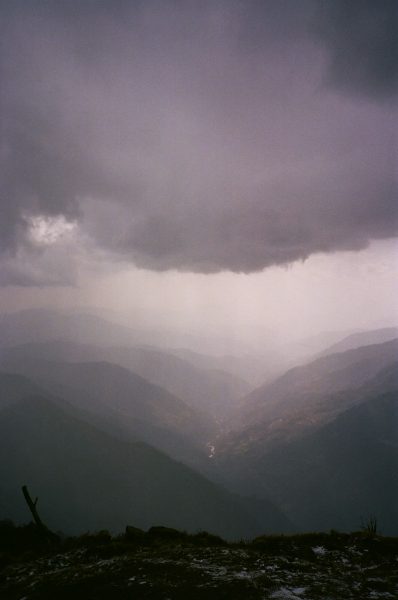 You tend to contemplate your existence at times like these. That we are specks on this mountain face—moving bugs upon the dragon at hand. The insignificance of the little things when life is truly so grand. The realization that you are in fact living, and not a zombie in a line. Your little actions; so small, yet so impactful when compounded. We often treat our planet without regard for this notion. We see our daily actions as having no consequence, or at least no consequence to us as the human species. Many modern day societies see humans as the center of the universe—every other living thing subordinate to our intelligence and revolving around the grandeur of humans. Much like our initial ideas about the revolution of the Earth, however, the rest of the universe does not revolve around us. As the Earth revolves around the sun in our solar system, we too are very much reliant on nature for our own survival on this planet. We have tried to separate ourselves from nature, but in reality, we are animals. Humans are another species on this planet, and an invasive one at that. We are in an era of mass consumption and mass expansion, and in the process, destroying entire ecosystems and increasing the temperature of our Earth. Glaciers and important ice stores are melting around the world—the Himalayas are not exempt from this. The direct Sanskrit translation of Himalayas is “home of the snowy mountains”, himal meaning ‘snowcapped mountain’ and laya meaning ‘home’. Yet snow is being evicted by humans from its home. Species in the Himalayas are struggling as a result of this, alongside poaching. The dragon is seeing human numbers atop its back rise, while snow leopards and Himalayan tahr no longer reside on as many of the stony ledges and snow filled slants of the mountain. Less musk deer rustle branches under the light of the moon.
Within this value system—that places humans as superior to all else—de-centering humans and making conscious decisions to do so might better connect us to the natural world. Freya Matthews explains, “Modern societies will become environmentally sustainable when they fit into nature, where by nature I mean the larger life-systems of the planet. Instead of monstrously devouring these life-systems, as we are currently doing, we need to get ourselves into ecological proportions, so to speak, becoming biologically integrated into the biosphere as a whole.” (Matthews 1).
I want to intimately know nature. To see a tree and know its name and its unique characteristics as a deciduous or conifer, drought resistant or intolerant, rapid growth or slowly building its body over thousands of years. To introduce myself to the tree and ask it for permission to touch its bark and stand beneath it. To see flowers and gaze at them in awe and watch bumble bees drunkenly amble along by, intoxicated by the flowers scent. To know herbs that heal various ailments – to be like the witches of old, so feared by the society in which we exist for their knowledge of nature. I want to see a rhododendron tree or an ant or a yak and know that we are equals in this world, unravelling the boxes and pedestals that society implants in our brains.
Baruch Spinoza, a 17th century Dutch philosopher, believed that God is equivalent to nature. In a time where it was not common to do so, he rejected the commonly accepted anthropomorphic idea of God as some external force acting on the world from afar, viewing God instead as an all-encompassing presence in all things—people, animals, inanimate objects. Believing that there is this divine presence in all things in the universe makes it so all things are ethically on the same level and all are connected. This doesn’t mean that we are all the same. We each have our different modes of existence—as a bush, as a person, as a rabbit—though each is as important as the next. This blurs the lines between human and nonhuman, between plant and animal, between mountain and trekker, connecting them all. Spinoza was a radical of his time, his work deemed as influenced by the devil himself. He was excommunicated from the Amsterdam Jewish community, essentially ostracizing him from society. Good thing he was a man, “burned at the stake” was off the table.
As we near the top, I am a part of the mountain. I feel its mystique enamor me. Its strength holds me up; its boldness opens my mind. The snow is the part of me that wishes to flurry and fly, the rock my grounded alignment, the peaks my goals. Any chill I had felt before, is warmed by the sun’s mighty glow. The snow, the mountain, my body, is all drenched in golden light. It glares off the white snow, causing me to squint at the world, reflecting light in all directions. I’m one of the last to reach the top, as I stopped too many times to count to take photos of the most beautiful sunrise that has ever graced my eyes. I feel the lightness of having reached the top, the satisfaction of making it, the adrenaline of existing in the place that I am. I enjoy pushing boundaries—pushing my body in the pursuit of mountaintops, but even more enthralling, pushing the barriers of society. I wish to never be put into a box, to never be so rigid in my thinking that I cannot change. Though early in my trip to Nepal, I can feel barriers in my mind being broken down, even if just the beginnings. In the months to come I can feel what is awaiting me, the realizations I’ve yet to have. The casting off of old structures and the rebuilding of my own life—culture, new relationships, and distance from the known helping me there.
Then, I am running. I am trudging through the snow, face planting and getting back up. I catch up to the boys ahead and we shout with joy—that very human urge to howl into the echoing chasm of a beautiful landscape and feel alive. A snow ball fight breaks out – we dodge and throw and laugh. It’s like the inner child that is awoken when swimming; in water’s frozen form, the reaction remains the same. We gaze out at the mountain for some time at the viewpoint and then make our way back to the rest of the group. They are sipping soup and sitting in chairs that have been pulled outside from the teeny tea house. We spend some time laughing and chatting and basking in the sun and the view it has afforded us. Soon it is time for us to head back down. Clouds begin to circle us, moving in to remove the view just as we decide to leave.
Recent studies have shown us that plants communicate with one another—signaling to one another of their presence, familial ties for some plants decreasing their root sprawling to make room for the others to grow. Mycorrhizal networks of fungi work in mutualism with plants, creating market deals with one another for the goods of each’s creation. Fungi provide minerals and nitrogen, plants provide glucose. Who’s to say we can’t also communicate with plants? Who’s to say there’s not some tie between us and geological formations? Even if only in our minds, it connects us to them and takes ourselves off of a pedestal.
I see the God in all that exists. I see ourselves as something that is a part of this natural world and not separate from it. I see myself in my hometown, nestled up next to the sea as I let it carry away my sorrows, the perfect listener to hold my tears. I think of the dogwood tree that was in front of my childhood home and crying when it was cut down. The beach that felt like my own oasis and the rock there that warmed in the sun, heating my body as I laid against it. The wind whispering its entanglement of life and death. The snow that falls in Himalayan mountaintops, to still the soul and open the mind. The dragon that is the mountain massif of which I walk upon, breathing with the tectonic movements of the mighty earth. The earth which will continue to breathe, to move and create life, whether humans are present upon its face or not.
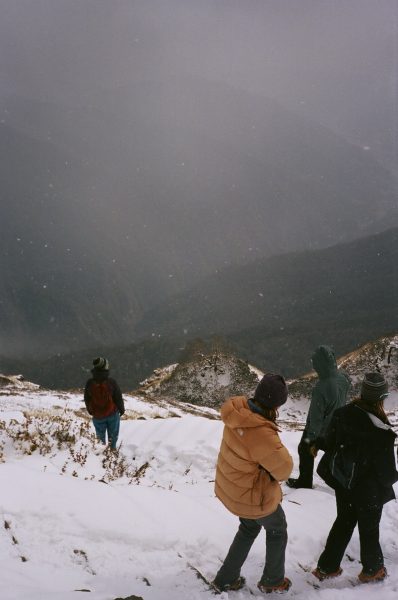
The rest of the day holds further descent down to lower altitudes, nearing the end of our trek. But for now, I let my walk connect me to the earth and slide into the rhythm of observation… and awe. The clouds coming in give way to silence and stillness and the excitement turns to reflection. One step in front of another, crunching the snow beneath me, having been melted in the sun and now crisping in the coolness of the cloud cover. The person in front of me walks in similar time, as well as the person behind. We are bound to this planet—to each other—and it’s bound to us as gravity pushes us to move upon it.
Rather than seek to dominate nature and slay the dragon of the Annapurna massif, it might be better if we were to nourish it. To level ourselves and allow for a reciprocal relationship to form—an ongoing conversation between humanity and nature. I wonder what revelations we might uncover, what marvels we might learn. Connections strengthened, each piece of us being fortified by the support of a world that we no longer ignore and push down. A world we embrace and nurture—its nurturance building community in the living and nonliving.
The crunching continues beneath my feet. The wind caresses my face and tightens with coolness. I forget to be present. I forget to embrace the earth. I judge without thinking and then have to retrace what I really think. But, I am learning to be present and notice the intricacies of life, and of nature. I am learning the ways to release my mind from the boxes it has created, to eliminate hierarchy within it. That is all I can do. Notice my actions and work each day to be a little bit better, a little bit more conscious. To allow continual learning from all things: the mountains, the wind, the relationships I cherish, the face-plants, and the trees.
Crunch, crunch, crunch. I inhale the cool wind and the mist of the clouds and the essence of the mountains and allow it to fill my lungs with its intelligence.
Additional Recommended Readings
Mancuso, S., & Viola, A. (2015). Brilliant Green: The Surprising History and Science of Plant Intelligence. Island Press.
Mathews, F. (2010). On Desiring Nature.
Meloy, E. (2003). The Silk That Hurls Us Down Its Spine. In The Anthropology of Turquoise: Reflections on Desert, Sea, Stone, and Sky. Vintage Books.