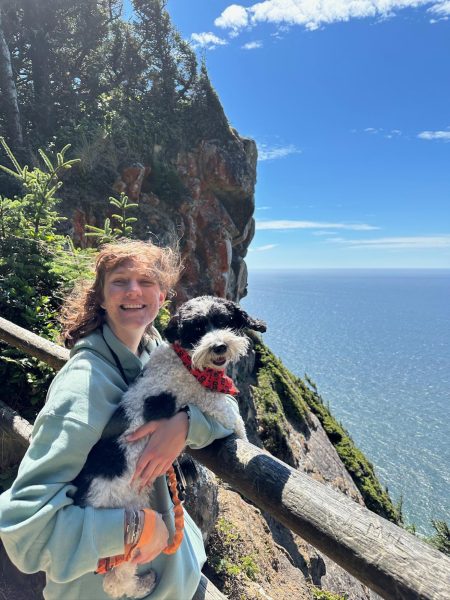

I have heard from incredible researchers from our university and the surrounding community across the course of my personal column, “Outdoor Research at the U.” Most of those researchers have been doing this for years — they have found their niche and built a deep passion for what they do. But what does it look like for the young researchers just starting out? How are real students at the University of Utah realizing opportunities in “outdoor” research? At a January social event hosted by the Wilkes Center for Climate Science and Policy, two students — both friends of mine — shared their research stories and were kind enough to take the time to answer my questions.
From the Lab to the Field: Jane Damstedt
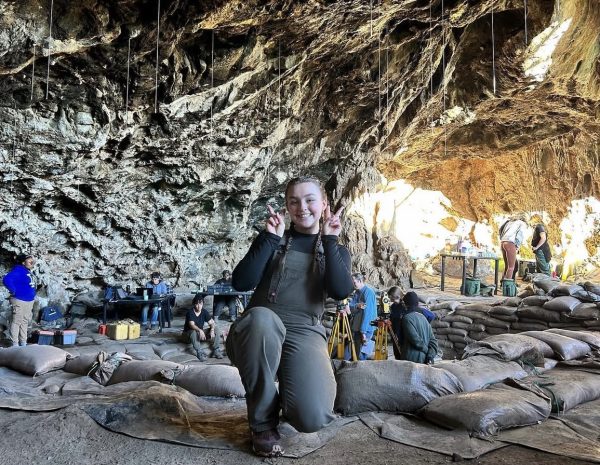
I met Jane Damstedt through laboratory research with Dr. Kasey Cole, now an Assistant Professor at Weber State University. Damstedt was — and still is — working additionally as a clerk for the Utah Medical Examiners’ office, and the detail-oriented lab work we were doing to identify animal bones was going to move her towards her goal of becoming a Medical Examiner. During fall break in October 2024, the two of us joined a collection of other lab and research fellows to camp in the western Utah wilderness. We spent two days digging through dirt and woodrat piss looking for animal bones, while others on the team set up and processed live mammal traps. So, how did a lab-focused girl end up camping in the middle of nowhere with a bunch of mammalogists?
Damstedt explained that her research involvement started with the Science Research Initiative (SRI) in her freshman year. She started out in a genetics lab and then switched to a virology (the study of viruses) lab for two years. After a brief stint in an evolutionary medicine lab and a series of mentors leaving for greener pastures, Damstedt ended up meeting Dr. Kasey Cole, whose work comparing mammal bones fit well with a path to medical school. Dr. Cole’s project, though, deals with a broader scope than just the body. Cole’s lab studies the ancient record of mammals that lived upon the landscape. This is used to understand how the environment is changing and is an active part of the Utah Caves Project, which I previously wrote about. And luckily for her, she fell in love with the work. She explained, “I think my project is important because by knowing how environments have changed over time, we can have a better understanding of how the same areas might change in the future.”
The middle-of-Utah field work, as well as the winding path through the research world, has given Damstedt a variety of transferable skills. She explained with a wide grin that those skills included learning — on the fly — how to change a flat tire during a quick trip back to civilization on that same October trip. “The variety of experiences that research brings,” said Damstedt, “including a mix of independent and group work, field excursions, typing on a computer and building a network of professional relationships, is also incredibly fulfilling.”
A New Outdoor Appreciation: Kaylee Meyers
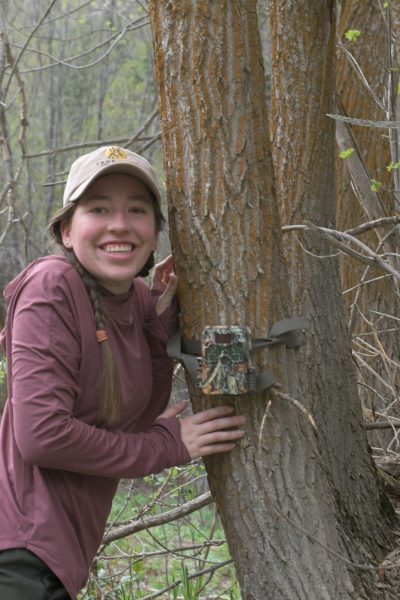
Kaylee Meyers, another research friend of mine, is a student researcher and project lead in Dr. Austin Green’s wildlife science SRI lab, which I have also previously highlighted. What Meyers shares with Damstedt is not only a love of environmental research but also a long and winding road to get where they are now. Meyers began her research journey with an SRI research stream studying ants. After that, and some dabbling in biochemistry research, they happened into Dr. Green’s lab. What started as trying something new to stay in the research spaces quickly turned into a deep love of fieldwork, of which Meyers explained, “It’s kind of … unmatched the experience you have. Like, [when] going up [Red Butte Canyon Natural Area], you don’t see anyone.”
Dr. Green’s lab uses trail cameras to study wildlife movement and distribution, and Meyers’ current project — their undergraduate Honors Thesis — uses this data to study how local wildlife responds to extreme weather events. As a part of this, she manages trail cameras along Red Butte Canyon, which sits above the University of Utah campus. Hiking up and down this natural area — which feels much more removed from civilization than it is — has given Meyers a new appreciation for the wildlife around us, and those that keep their distance, such as elusive and intelligent mountain lions. She and other lab members lovingly talk about the canyon’s resident female mountain lion, which is a prime example of human-wildlife coexistence. “It’s so cool to know that there’s like a mountain lion up there that could be following you at the moment,” Meyers said. “But … [in] 13 years of going up there, sometimes multiple times a week … no one’s ever seen her. Like it’s very clear from our camera traps that she knows where we are and when we’re there, but she never does anything.”
When asked to give advice for undergraduates looking to get involved with research, both Meyers and Damstedt said, essentially, “Say yes to opportunities.” While it is easy and reasonable to become worried about going out into the wilderness for research and that you might pick the wrong thing, these two student researchers show that exploring this incredible field will work out and give you many cool experiences along the way. The University of Utah is home to researchers eager to take students (safely) into the field, connect them with other labs that better align with their interests and share the fascinating outdoor topics they spend their lives studying. Everyone is welcome to get involved in outdoor research, even those about to graduate. Check out the rest of my “Outdoor Research” column to learn about labs and projects and maybe get involved too.