


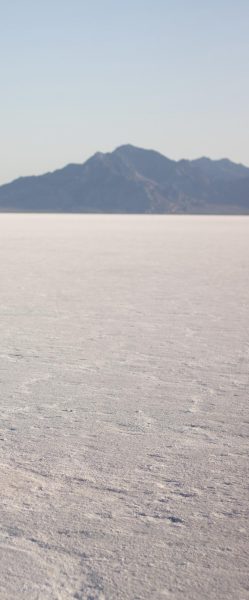
The ground is covered in white honeycomb patterning. The sky: a brilliant blue that stretches for eternity. Silhouettes of mountains grow in the distance as the sun burns the desert below. Utah, an alien planet to some, but the salt flats that sit just an hour and a half west of Salt Lake City are, unusually, not alien.
The Bonneville Salt Flats got their name from the massive lake that covered most of Utah in the early Pleistocene period, about 2.58 million to 11,700 years ago. After the lake evaporated and flooded into the Snake River, large amounts of salt and minerals remained. These salt crusts can range from a few inches to five feet thick. The flats are about 12 miles long and five miles wide, making them about 46 square miles in total. While undeniably beautiful, the process that created this natural wonder is just as interesting. By understanding the secret of the salt flats, we can discover how this salty desert played a huge part in the history and culture of Utah.
Salt Process
The once mighty salty body of water that rivaled the size of Lake Michigan ultimately lost its battle to climate change around 14,500 years ago. As rising heat and low humidity in Utah intensified, the lake rapidly evaporated, causing salt deposits to remain.
The salt flats mainly contain sodium chloride, but the appearance of other minerals such as potassium and magnesium can also be seen and create unique formations. After a while the salt deposits crystalize and form a hard surface. This hard surface creates the iconic white desert look.
What causes the honeycomb-shaped cracks in the salt is actually different from what scientists primarily thought. Originally, they believed that the cracks were caused as the salt crust expanded and dried out. However, newer research suggests that the patterns could also be caused by thermodynamics. Lucas Goehring, an associate professor of physics at Nottingham Trent University in England, said, “The surface patterns reflect the slow overturning of slaty water within the soil, a phenomenon somewhat like the convection cells that form in a thin layer of simmering water.” Under the salt is a layer of extremely salty water. In the summer the water evaporates, leaving just a layer of dense salt. After dense surface water accumulates on the salty surface, it sinks into the crust. Salt then forms on the crust and forms ridges. This happens because the outside edges have more salt than the middle of the hexagon shape. When the dense layer sinks, a hexagonal salt crust then forms around the outside of it. The crust is shaped like a hexagon, likely because of the convection and evaporation process in ties with the entire salt formation process.
History
Members of the Goshute tribe were likely the first to discover the Bonneville Salt Flats. For thousands of years the salt flats were their home. Members of the tribe would often go to the salt flats to collect salt in order to preserve meat. They honored the Great Salt Lake and the salt flats as an important part of their culture and heritage.
In the 1820s early trappers and explorers crossed through these flats when returning from California. Joseph Reddeford Walker mapped and explored the flats. He then named them and the prehistoric lake after his captain, Benjamin L. E. Bonneville.
In order to find a shorter route to the Pacific, John C. Fremont and his 1845 expedition crossed through the center of the salt flats. Fremont’s journey was replicated by a more infamous traveling party, known to many as the Donnor Party.
The thick mud that formed below the thin salt layer spelled out the Donnor Party’s doom. After their wagons got stuck, causing many to be abandoned, it delayed their journey through the Sierra Nevadas. Stopped by increasing mountains of snow, the members of the party were forced to wait out the winter. Only about half of them survived to make it to California.
Speed Racing
50 years after the Donner Party’s tragedy, publisher William Randolph Hearst hired William Rishel to bike across the salt flats as a publicity stunt. He completed the race in 22 hours. In 1925, after years of trying to promote automobile racing, Ab Jenkins, driving a Studebaker, raced a train across the flats. He beat the train by 10 minutes.
Because of the hard, flat, and large salty landscape, the salt flats attracted many people from across the world. It became the site of numerous land speed records.
Looking for another planet?
If you’ve ever been to the salt flats, it’s almost as if you’ve been transported to another world. The bright surface of the salt contrasted with the almost-alien blue sky and mountains silhouetted in the back is something out of a movie. In fact, many movies have actually been filmed in the Bonneville Salt Flats.
Popular films such as Pirates of the Caribbean: At World’s End and Independence Day used the salt flats to show both a large, expansive desert and an unusual alien planet. Movies also showcasing speed racing have been filmed at the salt flats. Such as Out of Nothing released in 2014.
The Bonneville Salt Flats are full of secrets. While to many the salt flats is just a pretty place, but from learning its science, history, and culture, it can become more than simply a salty desert.