

On Saturday, October 25, 2025, my alarm clock went off at 5:30 a.m. This was unusual for me, but that Saturday was special. On that early October morning, I was running out the door because I was headed to the 37th annual Bison Roundup on Antelope Island.
Sunrise Media Access
Those participating in the media caravan had to be there early. So, I found myself driving across Antelope Island’s causeway before the sun had come up. There weren’t many stars in the sky, and there weren’t any lights on the island itself. I couldn’t even see the island. I just barely made out the outline of the mountains, and I sure couldn’t see any of my favorite shorebird — the Wilson’s phalarope — or the wetlands framing the road. There was just the faint glow of the valley behind me. As I finally hit the island itself and followed directions from the flashing State Parks’ vehicles to the island headquarters, I wondered if the phalaropes were asleep somewhere in the plant life; I wondered if the bison were asleep too, the day’s plans unbeknownst to them. Then I hit a curve, and my headlights illuminated a hare darting into the brush. A snowshoe hare, I think — so some of the wildlife was awake.
I was one of the first to arrive at the park’s headquarters, but the rest of the caravan wasn’t far behind. We gathered in the small front room of the small office building, chatting and introducing ourselves. There was a lady from the Deseret News, some state employees, and even two representatives from a French television program. We naturally started shifting into something of a semicircle, and everyone trailed off as one of our guides moved to the front. There were three guides for the three cars in the caravan, but the one seemingly leading the day was Devan Chavez, an Associate Director of Utah’s Division of Natural Resources. He was tall and confident, and we could sense his excitement for the day as he detailed the rundown. The one time he became truly emphatic was when he said, and then reiterated, “If I yell ‘cars,’ then you get in, behind, or on the cars.” It made sense; it was bison we were dealing with after all.
Stop One: Cowboy Camp
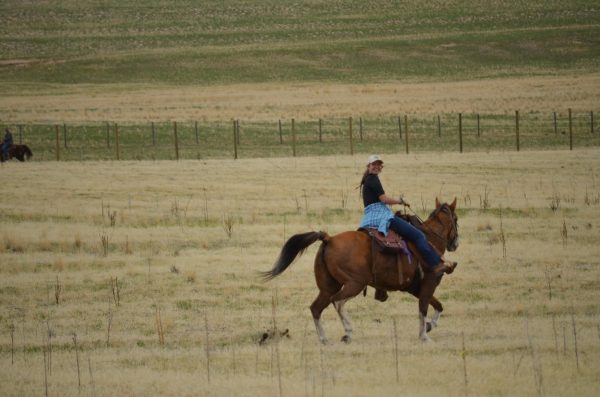
Bison Roundup is a yearly event that helps manage the island’s bison population and is the third largest roundup after the Yellowstone Bison Roundup and Custer State Park’s Roundup in South Dakota. In order for Antelope Island State Park to conduct a bison roundup, they must have cowboys — and cowgirls — to round them up, like any other cattle herd. There are nearly 300 riders in all at every roundup. Between 75 and 100 of them are hired by the State Park as part of the professional “posse” that makes up the team leaders. The remaining 200 riders are volunteers of all horse-riding levels who pay to join the roundup.
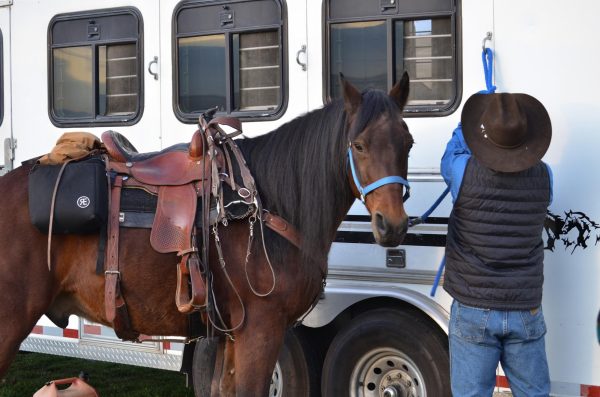
Most of the riders, professionals and volunteers came and camped on the island the night before. They were camped together across the road from the historic Fielding Garr Ranch, in a field full of horse trailers, temporary pens and RVs. The rest of the journalists and I were turned loose in this sea of ranchers about an hour before the event officially started. For a minute, I wandered and took in the camp, gently lit by the rising sun. But quickly, I got sucked in by the noisy horses and decked-out cowboys and cowgirls. I got to chat with a wide variety of these “cow-people.” There were older gentlemen, with worn chaps and welcoming faces, who had been riding with the roundup for almost 15 years. There was the wife of one of these men, who wasn’t riding but was helping in the morning preparations, and whose uncle was a biologist on the island years ago — he’s how the couple initially got involved. There was a father-daughter duo who had been doing this together for five years, and there was a somewhat nervous young man who was there for the very first time. There were even some dogs running around the trailers, but for everyone’s safety, they had to stay there. One young woman, I think her name was Chloe, was there for the first time with a horse she’d been training herself. While she was worried about her fresh young horse, I could tell she was even more excited to be a part of the roundup. Her expression was just as bright as her coordinated yellow hat and boots. Another rider, who was a friend of Chloe’s, wandered up, and his horse shoved her head right into my chest with just as much bubbly energy.
If it were up to me, I would’ve talked with every rider in that camp, but the roundup had to start, and the safety brief had to be given. The whole camp coalesced at the gate; a sea of cowboy hats surrounded the bed of a state park truck. Many of the horses had been brought into the area of the opening remarks. Some were excited, and some antsy. There were coats of all colors, from white and blonde to brown and black, and one on the fringes kept neighing through the safety brief. Everyone who got a chance with the mic reiterated the strong guidance on safety. They are herding bison, after all. Not your typical cattle, but bigger, faster and more aggressive animals. With horns. That’s why there was also a scattering of DNR law enforcement rangers around the event; their full police officer outfits were a reminder that the Roundup is still a modern event and not the wild west.
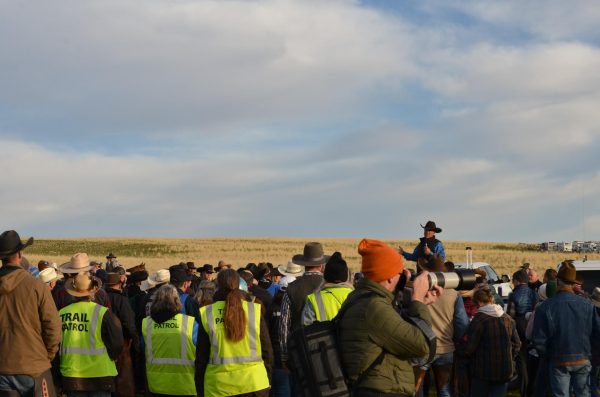
The safety brief was fairly straightforward. Rule one was to be smart and stay safe, and rule two was to never ride in front of the herd. Bison are wild, and they sure don’t like being told what to do. The riders are just guides convincing the bison of the best place to go. They do this by yelling, mainly, though some are given rock salt shotguns to use, which are meant to startle but not hurt the creatures. Many bring whips, though they were told to use them sparingly — if the bison gets used to the noise, then cracking whips will be no good. Flying in helicopters is a last resort, so everyone was instructed to keep the herd to the mountainside of the road and not let large groups split off onto the lakebed. And again, it was reiterated, do not get in front of them, and do not get too close. If a bison decides to chase something, it can run about 35 mph with surprising agility, and it will surely run the trespasser down. And one last instruction: nobody can take natural resources — bones, horns, plants, cool rocks — off the island. Though from the back of the crowd, one lady shouted with a laughing response, “But if you find my saddle bag from last year, grab it!”
Finally, before the start of the rest of the long day, Rios Pacheco, elder and tribal office staff member of the Northwestern Band of the Shoshone Nation, gave a traditional prayer and blessing. These blessings are a way to honor the ancient Shoshone people who lived in the area with the bison so long ago. It wasn’t until Rios finished the blessing and a sea of ten-gallon hats reemerged that I realized all the cowboys had removed them. Like during the prayers of my church, the group of predominantly white men removed their hats in respect for the prayer of an Indigenous tribe. A striking symbol of collaboration, and the necessary collision of ranchers and environmentalists that were about to pull off an incredible herding feat.
This is the first installment of a two-part article. Read about the rest of the roundup in Part Two.