

This is the second installment of a two-part article. Read about the roundup preparations in Part One.
The Start
When the Bison Roundup officially started the sun was fully up. I made a beeline for the media cars as riders mounted horses and hooves began to plod to the road. I was still watching them as I walked, still awed by the rodeo-feel of it all.
As the cowboys headed off to their ride teams’ colored flags, the caravan started off to where we were watching this year’s Bison Roundup. As we did, Devan Chavez, Associate Director at the Division of Natural Resources, told us more about the roundup and the island. The roundup is a huge event and has been for 37 years. Longer really, though the earliest years were not so structured. All that to say, the roundup is good for more than just managing the island’s bison population. It is a huge source of park entrance fees, which — alongside the gift shops — is Antelope Island’s primary source of funding. The park doesn’t get any money from the State. With the 3,000 public guests that show up for the roundup, it’s such a high-visitation day that the park has to cap the number of people that get to park along the long road the bison follow; the rest head straight to the rendezvous site. This year, there were only 500 people allowed on the road, but they still caused the caravan to creep along slower than Chavez would have liked.
The bison herd also has to be capped at 500. Though people have inhabited the island for thousands of years — Fremont Indian camps have been found there, and the Ute tribe frequented it until the 1840s — bison are recent residents. A herd of 12 bison were introduced to the island in 1893 in a conservation effort, and have since proliferated into a large herd that is currently the genetically purest herd out there. However, the island can only sustain a herd of 500, and significantly more will degrade the ecosystem and resources available to the native species, including the pronghorn antelope — which itself was reintroduced in 1997 after significant island ranching. With 200-250 bison calves expected each year, the island needs to boot some. How many, and of what age, are rounded up depends on the current state of the island and its resources, and what the breeding season looked like. Though every year only bulls, or males, under two years old will be captured. The older the bull, the more dangerous things get.
Stop Two: The Mountain
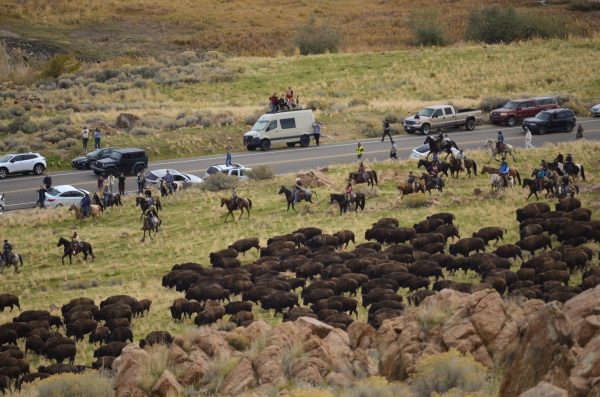
We ended up watching the roundup from above it. We were high up in the red rocks of the hill with a view of the plains, the road and the lakebed. There was a group of black colored birds flying below us that later perched on the lower stones. It was quiet for a long while; everything waiting for the cowboys and their herd. At one point the perched birds were looking out towards where the roundup’s “push” was expected to come, as if they could see them coming before the rest of us. And soon enough the wind turned. I could hear it below our lookout — a loud breeze that made it easy to imagine the stampeding of 600 bison feet. Then, sometime in midmorning, I heard the sound of one of the rock salt guns piercing through the quiet.
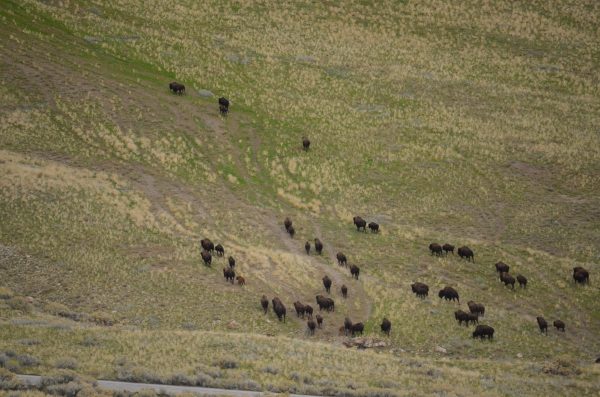
When the bison herd finally crested the far ridge of the plain it was hard to even see them. They looked like a pile of rodent poops, and as they did get closer, they looked like ants on an anthill. My throat was parched as I sat and waited, but even with the slow pace I didn’t dare go back to the cars for my water bottle. I couldn’t risk missing anything. It occurred to me then that, even if they didn’t intend it, calling the roundup a “push” was an apt description. It really was a labor. But finally, the cowboys’ whoops and hollers, and the horses’ cries echoed up to us. Though they were still too small for my camera lens, we were starting to hear them clear as day — and then, seemingly in a moment, they were right below us.
I have attended Antelope Island’s Bison Roundup two other times, both as a member of the general public. While it was impressive then, watching from the road, eye level with the animals, it doesn’t quite do the size of the herd justice. This time, I was watching from above — a bird’s eye view of the mass of brown bison being pushed along by a crescent arc of riders. As they moved towards the base of our mountain, they shifted; the line of riders moved parallel to the bison, placing themselves between the animals and the people on the road. It was a stream of bison and a stream of people — rivers of nowadays’ vans, history and horses, and the ancient ecosystem. The stream headed to our left, passed us and flowed up Heartbreak Hill — named for a horse who supposedly died of a heart attack pushing up the steep hill. Now, on longer roundups, the riders break for lunch at the top of Heartbreak Hill, and brown lines cut through the hill’s grass from 30 years of bison feet. When the roundup finally crested the hill, and the media caravan all turned towards the vans, I heard the dark-haired woman from Deseret News softly say, “Yahoo buckaroo.”
Final Stop: The Rendezvous Site
The Great Bison Roundup always ends in a wide-open field on the north side of Antelope Island. The permanent bison corrals are kept separate from the event site, but the riders pass the public rendezvous before they get to the corrals (with a more-than-sturdy fence between them). After the roundup is completed, the bison are “worked” during the following week. They are weighed, the young ones are vaccinated, and all otherwise are prepared for the auction.
Yes, the bison of Antelope Island are auctioned off every year. Jeremy Shaw, former park manager and this year’s pink-vested roundup leader, explained back at the cowboy camp where the bison are sold off to. “[The island] may have 250 animals for sale, and 210 of those may be calves,” he said, “Most of those go to feed lots. Most of them go to a single buyer. When they do the auction, if you’re the successful high bidder, you can buy five, or you can buy all of them. So, the first bidder usually buys about 90, because that’s what will fit in one of those big trucks. Then they send their truck out this way, they buy a whole bunch to put on feed lots and then fatten them up for a year and a half. Then, you know, they end up burgers and jerky and all that kind of stuff.” Shaw then continued, “Most of the two-year-old bulls go to people that want to start their own herd or hunters, believe it or not, people that have big pieces of ground that they’re going to turn their bison out on.” The bison who aren’t sold – typically pregnant females – are chipped and turned loose back on the island. The chips are used to keep a record of the bison’s vaccinations, pregnancy histories, and location, in case they become next year’s stragglers that the roundup misses. Watching the roundup, however, I could barely imagine there being stragglers. As the riders pushed the bison into the bottlenecked corrals, it was truly a sea of brown in front of me.
Somehow then, it was the end of the roundup. Everyone was clearly tired — in spite of, or maybe because it finished earlier than most years before. But as soon as it was over it was like the crowd let out a breath — and in that moment it felt like a celebration. The riders walked their horses back along the fence line, from the bison corrals to the gathering of food trucks, where they could finally dismount and get their horses back in their trailers. It was like a victory lap, a parade. It was like those small-time theater productions where the actors come out afterwards to shake everyone’s hands.
A couple cowgirls galloped past with loud cheers, and the crowd echoed them right back. A couple of restless kids nearby, clearly waiting on their parents, were still discussing the bison as I made my way lazily back to my car. When I finally got off the island, I could hardly fathom the excitement I still felt: the tired high hanging over my head, both completely satisfied in the event I got to be intimately a part of and wishing I could start the day all over again. I felt like my favorite shorebird, the Wilson’s phalarope, that spins around to find food in the water —and that I could finally see as I drove along the island’s causeway. The bison behind me, and the phalaropes spinning in their circles.