
“This is maddening.”
“A total joke.”
“You can’t even call it winter.”
To any Salt Lake resident reading this, you don’t have to be told what this winter has been like because you’ve been living it: the apocalyptic temperatures, smoggy skies, and the sporadic miserable “dustings” that are few and far between. For many of us, our annual snow is a part of our identity, signifying the time of year when the valley is hushed by blankets of snow and our mountains are celebrated. To be without this natural cadence of seasons feels unsettling, depressing, and, dare I say, wrong.
The Scarcity Hypothesis 
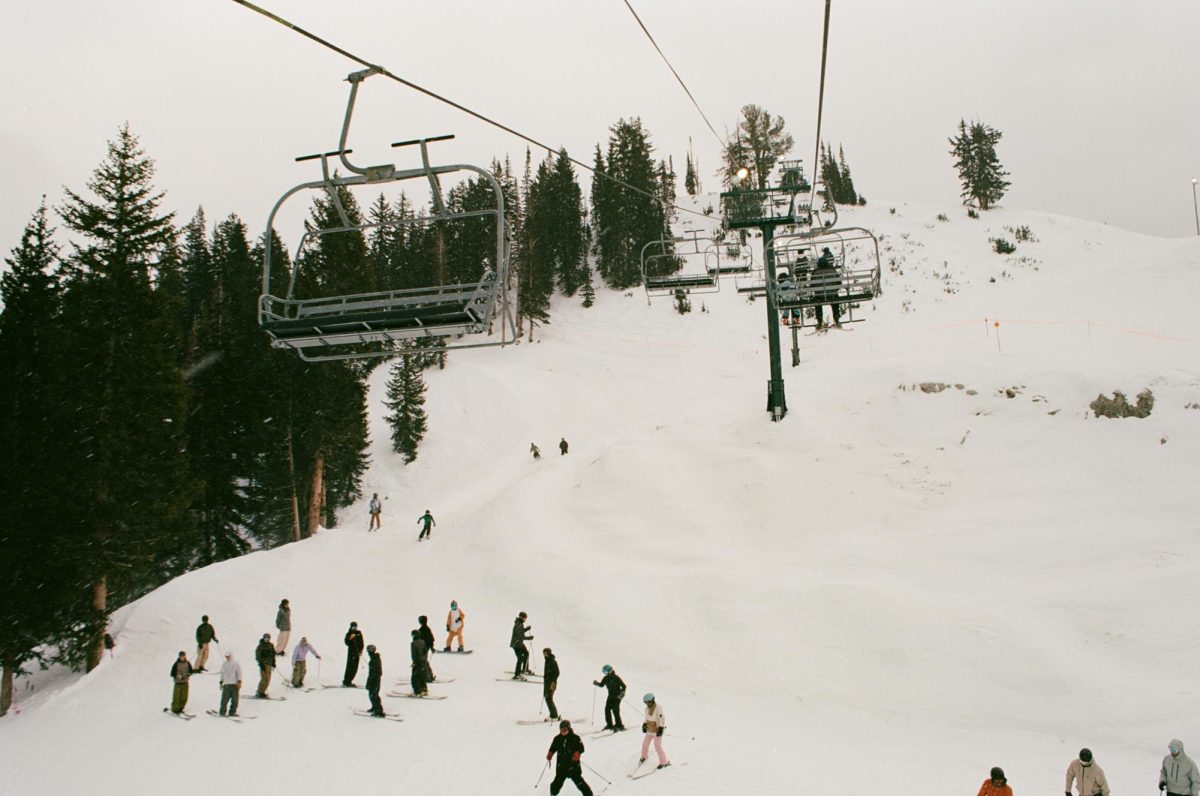
A large stakeholder in snowfall (or lack thereof) is the prominent winter sport community here. And although our local peaks offer some of the greatest skiing on earth, it’s becoming increasingly normalized to travel far and wide searching for the best untouched powder—something of a rarity these days. Passes like IKON drive incentives to travel to different resorts to maximize experience and overcome poor conditions by diversifying options. While this is not inherently bad, it drives the belief that “good snow” is a commodity, and one that can be bought. I don’t write this from outside the system; many of us, myself included, have felt the pull to travel in response to increasingly unreliable winters. The growing narrative that such snow is scarce compels our primal drive to chase increasingly limited conditions, thus perpetuating the paucity of the very resource we claim to treasure. This is not just the “skier’s dilemma,” and having a poor season on the slopes is assuredly not the reason for this piece. The problem has much deeper, more important implications for the Salt Lake community.
The Price of Powder
 According to the Kem C. Gardner Policy Institute at the University of Utah, in the 2024/2025 season alone, the ski industry in Utah generated $2.51 billion in skier/snowboarder spending and $342.6 million in state and local tax revenue. During the past season, the industry supported 31,800 direct jobs, emphasizing its importance as a source of employment for Utahns. Increasing temperatures threaten Utah’s local economy and job market, furthering feelings of desperation and deficiency.
In response to a warming world, more resorts are leaning on snow machines. Jackson Hole, for example, experienced delays in opening this season, and while they don’t rely solely on man-made snow, they are beginning to use this infrastructure more heavily to compensate for low coverage. Alta relies on Cecret Lake as its primary reservoir, siphoning water into the lake for storage and pumping it out to snow machines when temperatures are cold enough. This takes money, energy, and water—all major sacrifices—just to keep business flowing. As an industry that literally depends on snow, the patterns we are experiencing and those projected to occur are worth a conversation—a serious one.
Separation is not the Solution
If scarcity pushes us to treat nature as something to be rationed, purchased, or left alone altogether, then we risk losing the very connection that makes protection possible in the first place. Someone who has emphasized the importance of connection particularly well is the wildlife photographer Joel Sartore.
Sartore specializes in studio photography of vulnerable and endangered species. I attended a talk he gave back in 2021, and his message remains relevant. Sartore’s mission, particularly through his project Photo Ark, is to use his striking high-definition photographs of his animal subjects to engage viewers and spark a sense of compassion and care. Sartore aims to create connections between humans and the natural world and to help us realize that there was never a divide to begin with. He even advocates for zoos, quite a controversial position to take. His rationale, however, is that to protect something, you have to care about it, and to accomplish that, you first have to connect with it. 
Zoos aside, the sentiment of care, empathy, and love is not something we can afford to give up. In fact, I don’t think it’s in our nature to do so. Many may argue that there is “no time” or that it is “too late” to cultivate relationships with these spaces; that we must focus only on the logistics of immediate protection and conservation. While I am familiar with the push of urgency, I’ve come to recognize this approach as a potential pitfall. It’s exhausting and arguably counterproductive to live in constant reminder that we are against all odds to save the ecology of the world. Further, the driving forces of such colossal destruction are out of our hands. It is a sobering story of fear and isolation, echoed to us every day, and one that loses its weight with each utterance.
Connection as Conservation
Sartore’s philosophy is not limited to wildlife—it applies just as powerfully to snow. And when snow becomes something to chase, replace, or engineer, rather than something to be in relationship with, we risk losing not only an essential resource, but also the emotional connection that makes its protection possible.
What we can do is care. Connect. Appreciate. Notice. And no, it is not all for nothing, because when people care about something enough, there comes a shift. Cultivating a personal sense of place makes the abstract issue of climate change a tangible and personal thing. Once we can identify something that’s meaningful to us, we can do something about it, but until we do, we get lost in dizzying statistics and daunting headlines.
You don’t have to understand climate models to understand loss. You just have to notice.
“This is maddening.”
“A total joke.”
“You can’t even call it winter.”

These are expressions of grief. Not entitlement, disbelief, or even anger. It is an acknowledgment that something important is missing. It is a declaration of awareness and a recognition of loss. These are expressions of attachment and care. And while care alone cannot fix anything, it has the power to inform us of our values and impel us toward specific plans of action.
Get outside, find the snow. Even if that means traveling beyond the valley. Experience it so you can remember it. Remember it so you can miss it when it is not there. And in the meantime, think about one small way to keep it coming back, because snow matters here.