


A photograph has the innate ability to communicate something that cannot be done so in words. It is the universal language of humanity, transcending spoken dialects to communicate emotion and narrative. It is the medium of storytellers. To take a photograph is to pay tribute to a single moment in the grand chronology of time, to honor the fleeting interplay of happenings.
 I’ve grown a deep love for the craft ever since I was first introduced to film and digital in high school. Composing meaningful pictures started off as a school assignment but has metamorphosed into a pursuit, and as I’ve matured in my skills, I’ve come to realize how profound the art of photography is. It spans far beyond aesthetics, serving an instrumental purpose in history, journalism, social change, and science. A historian may explain how a photo materializes moments that may otherwise be lost and gives permanence to what was once brief. Those who lived in the wake of film might have had the privilege of having their photo taken—their portrait submerged in the liquid of immortality and silver nitrate. The journalist will add that the camera captures, too, the injustices of the world: war, famine, and violence laid bare across negatives and digital screens, demanding witness and memory. In tandem, the activist will state how these photos call for reform, for a change in order, and pledge to heal; how they unite millions of humans under the same shared hatred for suffering.
And the scientist. The scientist will describe how cameras reveal what the naked eye cannot see—the microscopic dance of cells, elusive properties of light, and even the distant cosmos of our universe. Through photographs, phenomena that are too small, too vast, or too ephemeral are rendered visible. They are born as a concept in our minds.
Perhaps this is what makes photography so influential in the context of climate change. I’m sure we are all familiar with the devastating images of emaciated polar bears on melting ice floes or catastrophic weather events overtaking whole communities. What’s important about these images, of course, are the events they depict. But what’s also important is that these images come with the notion that those polar bears were once well-fed with solid ice under their feet, and those communities were once unharmed. Climate change unfolds before us in a quiet persistence. Glaciers recede millimeter by millimeter while forests thin imperceptibly. Change creeps elusively across decades, and we are near-blind to its advances. Photographs give us perspective. They compress time and scale, making loss known and threats tangible.
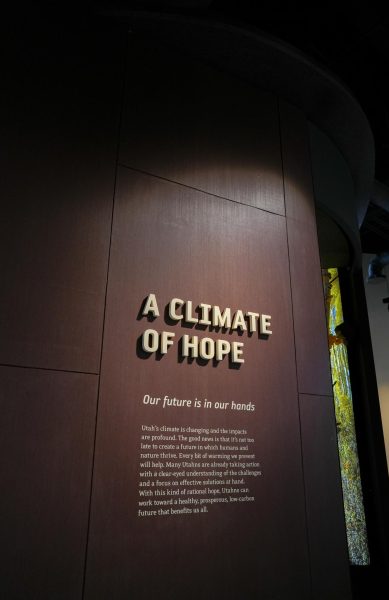
The experiences, perspectives, and lessons I have learned behind the lens have been the main inspiration for my thesis project, Visualizing Climate Change. For this independent study, I researched the correlation between various climate-related images and participant responses in A Climate of Hope exhibit at the Natural History Museum of Utah. The study looked specifically at how responses varied among visitors across five types of visuals. Some images focused on consequences and impacts of the climate crisis, while others depicted solutions. I analyzed museum-goers’ reactions to these images, looking for patterns in emotion, action language, and personal connection. The goal was to learn more about the power of visual media, specifically within a context about which I am deeply passionate.
I won’t bore you with a statistical synopsis of my findings, but I will share the most interesting patterns I found. Expressions of sadness, grief, and loss appeared more frequently at impact-focused visuals, while responses that included expressions of action were strongest at solution-focused images. The dataset includes more nuanced patterns and correlations, but the most significant findings are as stated. So what does this mean? Though I am unable to generalize these patterns or infer a causal relationship between image type and response, the patterns here are nonetheless interesting. Perhaps images framed through hope hold a distinct power in motivating climate action. Maybe consequence-focused images are necessary for inspiring urgency and compassion. This area needs more research, but there is no question that images serve a major role in climate communication, and their implications are, I believe, large.
This project has reinforced my belief in photography as a medium for change and has become a valuable tool for me to advocate for wild things. This magazine, in particular, has given me a platform to discuss environmental issues I care about while sharing meaningful photographs, and I am so grateful to have been a part of Wasatch for these past few years. This space has motivated me to get out into the environment, which I love; seek adventure; and take risks. In my time shooting for the mag, I have soaked up star-filled nights in southern Utah, exercising my long-exposure rituals deep into the nighttime hours. I’ve weathered lightning storms, eager to get the perfect shot at the expense of my comfort and warmth. I’ve taken impulsive day trips and weekend escapades in search of stories. And I’ve witnessed beautiful animals in their natural rhythms: bison wallowing in the dust, puffins among rocky alcoves, and a particular coyote who made me think.
Having a camera in my hand has changed my ability to recognize the miraculous potential of each moment. The frame becomes a doorway into observation and question, and the shutter announces its existence in the history of things. I hope to continue this practice—or way of life, rather—of noticing the story of the world and pointing my lens toward the things that matter most.