

The fall holds a special place in every climber’s mind. We etch out a spot in the shoulder season to travel to climbing areas too hot in the summer and too snowy in the winter. Having just gotten back from one such endeavor to central Utah’s Joe’s Valley – a world-class bouldering locale neighboring Orangeville – I began to think about these places through a different lens. We talk at length about how good the climbing and the climbing communities are in these places. But one striking thing I failed to consider in-depth is the local communities we invade as the leaves fall and the world cools.
Oftentimes these premier climbing areas are in close proximity to small towns, leading to an outsized impact on the community and the land. Orangeville, UT, Bishop, CA and Roy, NM are just a few such cases. I’ve seen first-hand in these places how the effect of climbers can be felt. So in this article I want to take a deep dive into this phenomenon. The good, the bad and, in some cases, the ugly.
Earlier Epoch, Local Epic
Revisiting central Utah from a climber’s point of view, the first thing you think of are the rocks, lots and lots of rocks. As you exit town and drive into Joe’s Valley, huge sandstone monoliths stick out from the hillsides. Boulders sleep in the emerald pools of the river. The chalk stains leave whispers of a delicate upward dance from decades past. Back in Orangeville you get a sense of harmony struck between us and the locals, but this relationship wasn’t always that good. As a matter of fact, it started off rocky, as a fringe sport collided with a small farm town. Moreover, it would have stayed that way if it weren’t for the help of Salt Lake native and outdoor advocate Steven Jeffery
Local Crushers Shape the Area
Steven Jeffery is a big name in climbing. I watched videos of him when I was a kid and remember being floored by the iconic Pusher poster of him on No Additives (v11). Jeffery began to visit Joe’s in the early ’90s. At the time he was one of a few Utah climbers unaware of the holy grail they stumbled upon. But over the next few decades he’d etch his name into the Valley as one of its strongest visionaries.
But as he himself notes in Kaya Climb’s article “Joe’s Valley Heroes: Steven Jeffery”: “…his crowning achievement to date is the work he has done to protect Joe’s Valley. Steven tells us, ‘I’m proud to sit on the Emery County Trails committee and help firsthand with the land agencies that manage Joe’s. As a climber living in Orangeville, I’m helping and working with a group of people whose goal is to protect Joe’s Valley the best we can for climbers.’”
For decades now, Steven has worked hard to ensure climbers treat Orangeville and the land around it with respect; he was at the forefront of integrating our sport and culture alongside the locals. In my opinion, no place exemplifies this harmony more than Food Ranch – the gas station turned climber bastion.
Placed right before you turn to go into the valley, it has always been the last stop for food and gas. But as climbers flocked to Joe’s en masse, it became so much more. Not only does Food Ranch sell tofu, vegan meals and a killer latte, but it is also the only gas station I’ve seen rent out pads and sell Tension Tape, chalk and branded chalk brushes. Food Ranch capitalized on the climber craze in such a positive way. On my rest days I can sit in the lounge upstairs with a coffee and a donut. Then, I can do homework on their wifi and yap with other climbers from all over the world.
Joe’s Fest, a Lasting Legacy
I couldn’t talk about the impact of climbers in Orangeville without talking about Joe’s Fest. It’s an annual celebration of community, climbing and preserving the land we enjoy for generations. Having started in 2015, it celebrated its 11th year while I was in the Valley last. I talked with some fellow New Mexicans visiting for the weekend. They said they were headed to a pizza-making clinic after their morning bouldering session – a statement that I think captures the spirit of the festival perfectly. Its goal is to show climbers the local happenings and vice versa. With events ranging from climbing clinics to rodeos, a key aspect of Joe’s Fest is trail building and preservation days, where climbers and locals alike work together to maintain Joe’s Valley for all.
While Joe’s Valley is a case study of climbers working hard to preserve the land and ties with locals – even after a rocky start to these relationships – not all climbing areas are so lucky. While we can look back on Orangeville as a continuing success, some areas like Bishop California have encountered more adversity.
The Next Big Boom – Bishop
Nestled in the Mojave Desert and straddling the Sierra Nevadas, Bishop is a tiny city of around 4,000 people. Even before the climbing boom, the city had its fair share of seasonal outdoor nuts in the form of skiers headed to Mammoth Mountain. But then, as Wills Young wrote in his Rock & Ice piece “The Sky is Falling”: “In the fall of 1999, Chris Sharma moved to Bishop, California, to boulder. In the fall of 2000, everybody else, including me, moved to Bishop to boulder.” After Sharma’s ascent of The Mandala (v12), Bishop became an overnight sensation, becoming as viral as a somewhat fringe sport could become in the infancy of the century.
The short-term tangible effects were overall positive. The local businesses saw a huge influx of traffic, and the prices of homes began to rise. But, as Young notes, “The increase in traffic at the Happy boulders — more than 12,000 visits last year (~2001), up from zero six years ago — so alarmed the Bishop Bureau of Land Management . . . BLM employees spoke of feeling overwhelmed . . . As the visitor numbers continued to mushroom, relations between the BLM inevitably began to strain.”
As Bishop continued to swell on the world stage, eventually overtaking Hueco Tanks – the area many consider to have spawned bouldering as we know it today – the typical dilemmas of a new zone came to light. Should there be a guidebook? Should we monetize camping or promote dispersed camping? Meanwhile, there were far more pressing issues that were swept under the rug. Primarily the fact that the Tablelands, home of the famous (and today somewhat infamous) Happy and Sad zones, encroached onto native land of the Paiute tribe. People knew early on that these boulders hosted rock art, and climbers did their best to preserve it by not allowing climbing around it. But the longer-term effects of this takeover weren’t felt that early. In fact, they were not an issue when Young wrote his piece in 2002.
The Lasting Effects
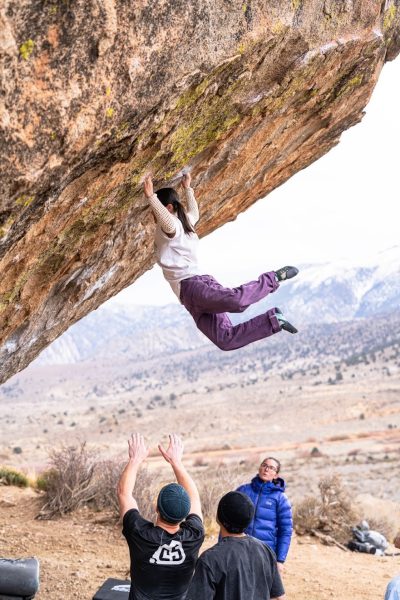 Fast forward to 2024, and long-time dirtbag and author James Lucas showed a different story in his piece “Flood in the Desert: How a Tidal Wave of Climbers is Reshaping Bishop, California.” Lucas interviewed Shondeen Chavez, a Paiute Native and cultural affairs director for Bishop Area Climbers Coalition. He reminisced on hunting small game in the Tablelands as a kid. The vegetation among the rock fields allowed rabbits to hide, but has since been stomped on by the unaware climber. Having visited the Tablelands as a climber for the first time last year, I found it hard to envision the place as anything but a bouldering area. This, I believe, is a root cause of the trouble.
A common idea among the community that I’ve heard is that Bishop is where people from the big California cities go after they caught the climbing bug in the gym. This leads to inexperienced campers and outdoor enthusiasts seeing the bouldering zones as just that. Not as native land, locals’ backyards or simply grounds worth preserving. Although this theory is rooted to some extent on the bias of “these darn city folk just don’t get it,” it does have legs to stand on when you see a Sprinter van squished into flora because there wasn’t enough space in the campsite. Or when you see dogs running wherever they please while owners are too busy down-climbing from a highball they didn’t scope out properly.
Where Does Bishop Go Next?
Chavez notes that his tribe would like to see “restrict[ed] access to the Tablelands in a Hueco Tanks–style plan that would allow for regrowth of the flora and fauna.” This is a plan which climbers may hate to see, as Hueco Tanks is now hard to get a guide for, and free roaming access to the area is restricted to a single zone. But this might be what we deserve, or it’s simply a needed antidote given the sheer number of climbers Bishop sees in a year.
The coexistence of locals and climbers in Bishop is ongoing, and certainly more fragile than those in Orangeville. Is that just because it’s a newer area? Is it because it had a bigger boom? Or can we just use the faithful scapegoat of blaming Californians from the Bay and LA for all of Bishops troubles? … Well, I don’t have the answer, so don’t look at me!
A New Frontier in New Mexico
We’ve explored two distinct eras of bouldering in small communities, and I want to propose a third: Roy, New Mexico. As a New Mexican, I will fight tooth and nail for the fact that Northern New Mexico is the prettiest place on earth. That being said, as you drive north from Santa Fe on I-25 into the area around Roy, my argument stumbles. It is flat farmland for as far as the eye can see.
The town itself hosts a whopping 200-odd residents; it’s in essence a single street with a handful of offshoots. My one interaction with a Roy local was a very pleasant man who, after I accidentally drove onto his property, pointed me in the correct direction, knowing where I wanted to go because of the “silly mattresses” in my car. But as soon as he pointed me in the right direction, and I drove through what felt like a dozen gates that needed to be opened and closed to keep cattle in or out, I was stunned by the sea of boulders hiding in plain sight.
The Spawn of a New Bouldering Zone
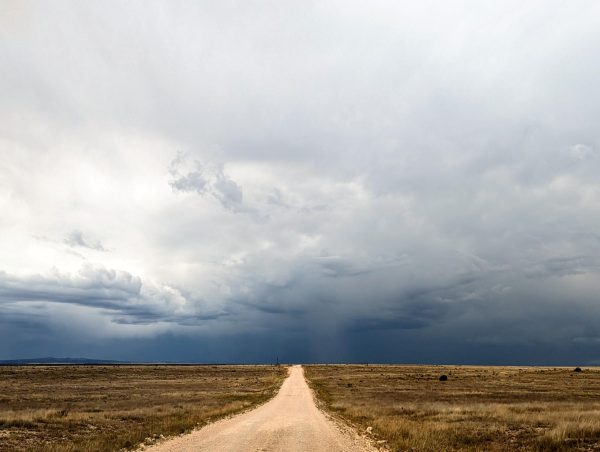
As a climbing location, Roy is still in its infancy. As it sports a couple hundred boulders on Mountain Project (certainly only a percentage of established lines, and a drop in the bucket of potential ones), it is beginning to see the same growing pains of areas in the past. Who should write the next guidebook, and do we even need a guidebook in the digital age? How should we run campgrounds? And can we please get an outhouse?!
In the mid 2010s, legends like Jason Kehl and Paul Robinson paid the area a visit. Since then, the traffic through Roy has only increased. While its remoteness may add to its preservation, the size of the town makes it far more vulnerable to climber-local disputes. Thankfully, we are capable of learning from previous mistakes, and NM guidebook author Owen Summerscales, whose 2016 guidebook New Mexico Bouldering was the first to include Roy, is taking every precaution. Summerscales noted in a statement on Instagram that, “I am very aware that the book brought Roy in particular to the masses, and some weight is on my shoulders. I do not want to publish any more updates for Roy climbing until we can be sure that there is the infrastructure to cope with the crowds that another guidebook update would bring.”
What Can We Do?
While Roy is far too young to know the true impact that climbing will bring, we can watch it with eager eyes and climb with cautious heads, knowing full well that the implications of our actions as climbers and outdoor advocates can be felt for generations. Bouldering is only getting bigger, and its new acolytes are being spawned indoors far more than outside. Given that, we must understand how crucial it is to teach outdoor ethics and leave no trace policies, because we will continue to climb for generations. Our goal is not only to try our hardest on the rock, but also to ensure that everyone that comes after us can too.
If you need a reason to protect these places, and the relationships with its people, I encourage you to take a weekend to go to Joe’s Valley. Enjoy climbing on the historic lines, then grab a donut at Food Ranch. Perhaps then you’ll begin to understand its importance.
Sources:
Reed, Emily. “This Tiny New Mexico Village Is a World-Class Climbing Area.” Outside Online, 12 May 2022
Lucas, James. “Flood in the Desert: How Tidal Wave of Climbers Is Reshaping Bishop, California.” Climbing, 8 Nov. 2024
Kaya Climbing. “Joe’s Valley Heroes: Steven Jeffery.” KAYA Climb, 14 Sept. 2024
Young, Wills. “The Sky is Falling: Are Bishop’s Bouldering Divisions Simply Signs of Growing Pains, or a Paradise Already Lost?.” Rock & Ice, December/January 2002