

I want to begin this article by looking back in time to an article I wrote freshman year called “A Moral in the Mountains.” In it, I reflected on a day out in Red Rock Canyon National Conservation Area, NV, where a last-minute change of plans to our climbing day led to what felt like a total epic…not in a good way. You can go read the piece if you’d like (although I might not encourage it). In short, we got on a climb with inadequate gear, in below-pleasant temperatures, and I was pretty rattled.
Now, I don’t encourage you to read this article—I hate it. The reason I loathe this article is twofold. For one, it felt self-serving and full of hyperbole. This is something I made light of in the piece, albeit not very well. To any seasoned climber, this day would have been a nothing burger: you try a climb, you get a couple hundred feet up, and you bail. So what? What? The second reason is because the article itself was a non-starter. I don’t believe it served any purpose to the reader.
Now with a few more years of writing and climbing under my belt, I stumbled across an opportunity to revisit the piece, the idea, and, in some ways, the climb. Coincidentally, I also feel horribly reflective and introspective as this is my last piece for this lovely publication—barf!
With that, here is an earnest second attempt at making use of the lessons I’ve learned in the mountains and in writing to reflect and, hopefully, inform.
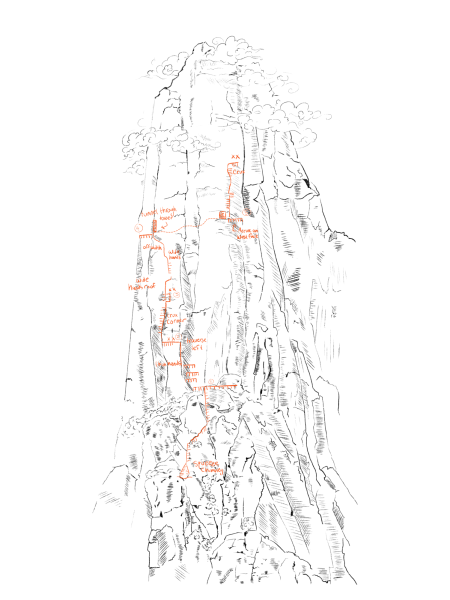
Almost exactly four years later, I once again found myself in Red Rocks, once again hiking up Juniper Canyon, the same place where my day went awry years ago. This time I wasn’t here for Crimson Chrysalis (the climb we bailed on); I was here for its neighbor, Cloud Tower. Soaring 800 feet into the sky, this spire boasts one of the greatest hard crack climbs in the US. It’s spoken in the same breath as The Naked Edge in El Dorado and Astroman in Yosemite. Though, this is not something I can independently verify. My climbing partner and I had been talking about attempting this climb for years. We went so far as to use the StairMaster to improve our calf strength, a tool few climbers dare try to harness.
In short, the climb went amazing, but not because it went perfectly. This is where my second attempt at a decent piece begins.
Be Excited to Fall
If there is one thing I was most afraid of heading into college, it was failing. I had an air of uncertainty around me and debilitating imposter syndrome. I never felt willing to give anything a real honest try. In fact, one of the first things I did that felt like a long shot was applying for this magazine. I hadn’t had much experience writing, but I knew the little I had done was enjoyable. Importantly, I recognized that being a good writer can be a gateway to great things. Cedar Wright. Beau Miles. These are good writers, and they are some of the coolest humans romping around this planet! After interviewing with the editor at the time and being reassured that by no means must I be a Pulitzer winner to write for a student-run magazine, I went for it.
 Since then, as I’ve already mentioned, I’ve made some flops. I’ve written pieces that were far from perfect and have taken photos that weren’t all that great either. But shortcomings leave opportunities for growth in their wake. I can say for certain that if I hadn’t written bad pieces, I’d never have the skill to write good ones. The beauty of writing for a magazine in college is that you’re allowed to fall short. You get to learn how to do the job better in the real world. No assignments, no professors. Every mistake is yours to own and learn from however you’d like.
It should go without saying by now, if you have any interest in working in media, start now—perhaps start here!
In preparation for Cloud Tower, my partner and I had been going trad climbing in Little Cottonwood. By far the most daunting aspect of trad climbing, as opposed to normal sport climbing, is placing your own gear. I still get antsy taking falls onto bolts that could hold an elephant. How am I supposed to trust a piece of metal I stuck in the crack myself? My first fall trad climbing wasn’t really a fall; I had yelled “take!” and nervously sat back into my rope. My polished 0.75 Camelot I bought used at IME was not instilling confidence. It sat wedged poorly into the smooth granite split that ran down Bong Eater Buttress.
“I don’t know, man, this piece doesn’t look that good!” I yelled down. He replied: “It’s ok, just trust i–”
Before he could finish the sentence, the piece blew. I fell and found myself sitting in my harness several feet lower on the cam below. My partner laughed. So did I; the comedic timing was flawless. Since then I’ve tried with decent success to convince myself that 99% of falls are harmless. Furthermore, 100% of falls offer a learning experience you couldn’t get from anything else. Beyond that, it’s started becoming a little fun, falling short and feeling your body pendulum back into the wall.
Yell “Woohoo!”
The start of Cloud Tower went amazingly. The first pitch was a lovely 5.8 cruise, taking the entire length of our rope to get up. The second was a beautiful sandstone crack followed by a committing karate kick and run-out climbing on the lichen-painted face. We even cleaned up the crux pitch fast. It was a fingertips-sized splitter crack sandwiched between two blank perpendicular walls. The climbing wasn’t easy, but after 50 feet of wrestling our fingers into any piece of rock that would have us and pressing our feet against the small dimples in the otherwise featureless wall, we made it. And we were psyched.
It was on the 4th pitch of Cloud Tower when another lesson I’d learned came in handy—faking it. I had placed two pieces in the first section of the climb, which I quickly learned was two too many. I got into a flaring, wide crack, and most of the pieces large enough to be helpful were now below me. My nerves quickly spiked, and I hollered down to my partner that I was becoming a bit hesitant.
In reality, I was very scared.
I began bumping a C4 Camelot up the crack with me, and with every move, my stomach knotted itself into an ever tighter ball of anxiety. I took a breath and said, “Woohoo!” I was attempting to convince my brain, now relying on primordial instincts, that I was excited, not scared.
This was a trick my brother taught me when we were kayaking down Browns Canyon on the Arkansas River. I was horribly nervous knowing that we were coming up on the biggest rapid in the canyon. Unlike climbing, where you may be able to stop and collect yourself, in kayaking you’re not afforded that luxury. Historically, rivers don’t wait for you to be ready; they just keep moving. As the gradient downriver began to steepen and the horizon got closer, he paddled up next to me, and told me, “When you’re nervous, yell ‘woohoo!’ You’re excited, not scared.” He said that the two emotions often feel the same.
I got through the pitch, and after belaying my partner up, my nerves began to calm down. There were places on that climb where I realistically couldn’t afford to fall, where I found that I had to switch my mindset from “let the fall happen” to “you’re excited, not nervous; keep going.”
If you think this trick is a stretch, I don’t blame you. I didn’t believe it either, but I encourage you to try. You might be surprised by how similar the sensations of anxiety and excitement are. It’s just butterflies; who’s to say that’s a bad thing?
Pushing Further 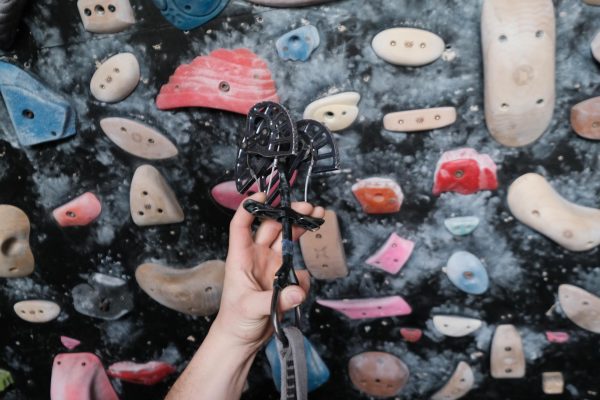
The last pitch was hard, very hard. My partner and I spent roughly three hours on the belay ledge taking turns trying to figure it out. My first attempt left me whipped; a foot slip on the way to the finish hold sent me down instead of up—not usually the direction of choice for climbers. I was devastated. I was exhausted. I really didn’t want to try again.
As I lowered back to the ledge, I formulated excuses. “I’m too hot. I’m too tired. My body hurts,” I told my partner. Luckily for me, he would have none of it. He retorted, asking when the next time I’d be up here was and if I was really going to come back to Vegas, do this hike, and climb the 700-odd feet to get back to this point. I tried to play it off like no big deal, but he was right. The climb chewed me up, spat me out, and left only a cramping body full of crippling self-doubt. But I had to try again. I had to yell “woohoo” and try again.
We both conquered the last pitch and rappelled down to the ground. To be honest, I can’t remember many details. But as we hiked out under a veil of stars, I began reflecting on the day we had. This climb had meant something; it was a sign of growth. One of not just physical growth but a shift in my mindset. I was thinking methodically in situations where my mind just wanted to yell. That was the difference between four years ago and now, simply thinking more. I am thinking more in my writing and in my climbing. I guess I’ve learned at least one thing in college.
Write it down.
Now I sit reflecting on a climb that granted me fugitive euphoria but whose touch will be felt perpetually. Doing something that pushes your limits is euphoric. When something demands entirety, you have no room for excess thoughts. Tunnel vision: you can’t waste energy taking in your periphery. Your mind is contracted in whole by the task right in front of you. The consequence, when the job is done and your mind eases its restrictions, is a rush of feelings. Those that sat on the sidelines when your body needed to react flood back into you.
This feeling is fleeting, worth chasing for sure, but never permanent. What is permanent is the subtle touch that these experiences leave on you. Whispers of what was, just enough to make you want it again.
I find purpose in the outdoors because it grants me a myriad of emotions: adrenaline, clarity, anxiety, and joy. A life outside demands more physically and mentally than anything else I’ve experienced. I find that these emotions leave quickly. Sure, I was on an adventure in a sea of sandstone last week, but this week I’m back in the engineering building decoding my professor’s handwriting. That is why I find it important to write those feelings down. Despite how visceral these emotions are in the moment, they will only fade if I don’t immortalize them in text. Luckily for me, I have Wasatch, which gives me a pretty good excuse to do just that.