


The history of climbing in the United States is closely tied to Utah – from early mountaineering in the Wasatch to cutting-edge trad climbs splitting the granite walls of Little Cottonwood. Bouldering took some of its infant steps in Joe’s Valley, and the first 5.14b in the US was put up by Boone Speed in Logan Canyon. However, if Utah were just a piece of climbing history it may have faded into obscurity by now, but we all know that isn’t the case. While Utah’s continued influence can be chalked up in large part to the vibrant community and abundance of perfect rock to climb, you really can’t capture the true past, present and future of our sport without mentioning Pusher.
Started by Dave Bell here in Salt Lake City, Pusher has been shaping climbing holds since climbing holds started shaping climbers. Today it is owned by crusher Jared Roth, along with long-time partner-in-crime Kevin Matuz as they continue Pusher’s legacy – tools created by climbers, for climbers, to push themselves harder.
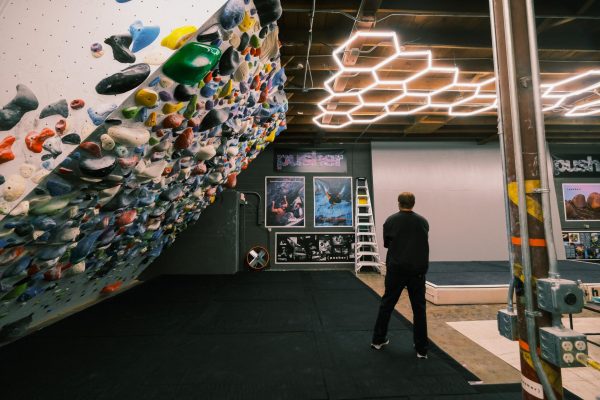
I had the opportunity to sit down and talk with Jared about his climbing origins and the origins of the iconic brand at Pusher HQ in downtown Salt Lake. As you walk in, you’re greeted by his very bouncy dog who insists you ought to throw a ball for them. The front office is unassuming: cool posters, a conference room table, Kevin’s desk and a steel door leading to the workshop. To a climbing nerd, that door is like the gates to Willy Wonka’s Chocolate Factory.
Inside: a huge wall, every inch covered in climbing holds. A campus board with “YOU ARE WEAK” written in chalk at its base. Foam mockups of soon-to-be climbing holds are on the table, and underneath are boxes of those that didn’t make the cut. This was the setting for our conversation that went for hours, covering decades of climbing history and dozens of topics.
This is a collection of the most interesting and memorable moments.
 How did you start climbing?
Jared: I started right after I turned 14. I think it was actually April 20 of 1996.
Aidan: 420?
Jared: Yeah. I didn’t realize that until I looked back later, because it was like the third Saturday of that month and I looked and was like, “Wow, that’s funny.” I lived down in Midvale area at the time. And there were two gyms in Salt Lake and one in Provo. And the one that I ended up going to was the Wasatch Front Rock Gym.
Aidan: I was going to ask if it turned into the Front.
Jared: Yeah, the very first gym in the Salt Lake Valley was called the Body Shop and it was in Sugar House. Dave Bell, who actually is the guy who started Pusher and who actually started what turned into the Front, started the Wasatch Front Rock Gym. And so that’s the gym I started climbing at. Most of the real climbers would just come in and climb around on the bouldering wall. And it was just like holds all over, like every single hold we had, we would put them up until either you ran out of bolts or you ran out of holds. So that’s where I started climbing.
About the history of Pusher, when did you come in and buy it and why?
Jared: Yeah, well, I guess to start that off, I bought the rights to Pusher because it had been out of business for a few years. I got back into making climbing holds full-time in maybe October of 2015. I was working at the hold factory of Vertical Solutions, and I was like putting all these holds in the bags and was like, “Man, if this is what people are buying these days, I bet you I could make better holds than this,” because I’ve climbed a lot. And so I wanted to start my own hold company, and I was trying to come up with a name for it and I was like, “Man, I just want to make like a new version of what like Pusher was and what it meant to me when I was younger because it was like the coolest brand and had really cool holds and stuff. I don’t know if I can come up with something better than Pusher or even as good, much less better.”
And so I reached out to my friend Clark (Pushers then-owner), who owned Cordless and used to sponsor me when I was younger. And I was like, “Hey, are you ever going to bring Pusher back again or are you just going to let it like, you know, rot away in a storage unit, and I was like, ‘Do you want to pass the torch, you know?’”
And he said, “Well, you know, for some money, I would.” And I was like, I was like, “Oh, man, I don’t have any money right now.” So we got talking for like six months or almost a year and in the spring of 2017 is when my Pusher got resurrected. And I was like, well, it’s kind of a gamble, but we’ll see if everybody else remembers Pusher as much as I do. And it ended up working out well.
Can you tell me about the process of making holds like that and how it’s changed?
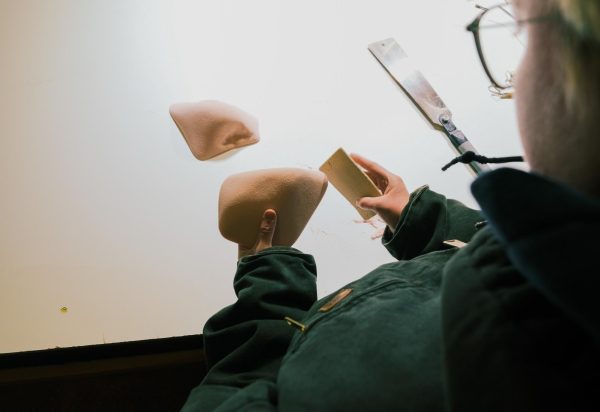
Aidan: I think the Fontainebleau holds have become one of the most famous hold sets ever. Maybe infamous, even. How did they come about? Because they were sort of revolutionary then and still today.
Jared: So the very first Font hold was “The Boss” shape. I believe it came out in 1998. And I was actually working at the Wasatch Front Rock Gym when the Pusher guys brought that down one evening and were like, “Check this thing out.” And we were like, “Dude, that thing, we might screw it to the wall. It might rip off. Or what if you hit your elbows on it because there weren’t volumes and these big, huge fiberglass things and stuff back then.”
So it was the biggest hold in the gym. Also, everybody’s broke, so they couldn’t afford a big hold. But they made it anyway.
And then the first, most classic Font stuff that came out right around then in the same style, basically, they took the Boss mold, and they take other shapes and like wedge chunks of stuff and wedge it between the silicone and the shell and tweaked the mold and made it into kind of a weird, different shapes. So almost all of the original Pusher Font stuff was just weird tweaks and one-offs of the Boss that then they turned into like production tweaks so that they could pour it the same for everywhere.
If you were to ask most people that have been around awhile, almost every single one of them will say that the Boss is the most famous Pusher or most famous shape in the world.
It’s also kind of the thing that made people go, “Oh, man, when you’re out away from the wall, because the hold’s so big, it almost changes the wall,” so it’s not like board climbing anymore.
And then that’s kind of where volumes and these macros and fiberglass things came from because then we realized, well, you really can change the wall a lot. You make it three dimensional. You get more body positioning moves and different stuff and that all came about — it all came like after that hold.
With these holds that are meant to resemble the outdoors, how do you balance that with an indoor style of climbing?
Aidan: Understanding that the people buying this are going to be putting it indoors. They’re going to be setting indoor-style routes, but people still like the outdoor feel, I mean, the Font slopers are in the World Cups.
Jared: In general, most of the rock texture type style climbing holds have kind of gone out of style for the last five or 10 years. Like worldwide, basically, and people are more into just simple, smooth stuff, which is cool.
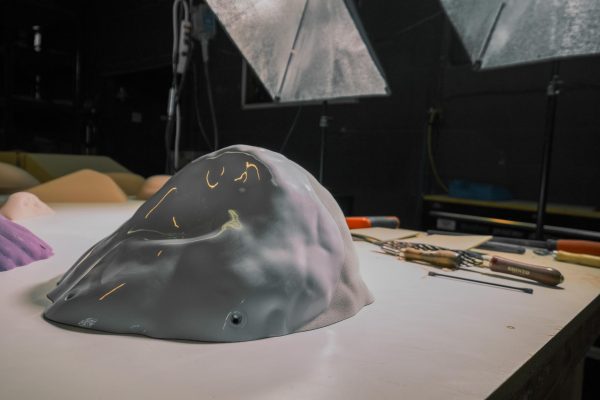 So it might not actually even sell as good as you thought it was going to sell. Usually when I make something, I try to make something that I think is cool and whether it’s just a simple shape, or resembles Joe’s or Font or whatever, I try to make it like where I’m like, “This hold is a classic.” And since I’ve been climbing for almost 30 years, I think I’ve got kind of a good idea. It still might not be everybody’s cup of tea. I do think a lot of companies probably look at what they think is going to sell well, and that’s what they make. I usually try to make stuff that I think is really cool, and then I hope it sells well. And if you make a really, really cool Font hold or Joe’s hold or something, people will go, “Oh, wow, that guy knows how to shape a hold.” I can’t just bring back like one of the most famous hold companies in the world and just make a bunch of smooth jugs or something because I think it’s going to sell well.
Aidan: Would you say that the rock-like holds are done for?
Jared: It does seem like rock stuff might slowly be making kind of a comeback in some of the gyms, especially worldwide, because there’s some people, especially in Europe, that are starting to go, “Hey, we think we’re kind of getting tired of all this simple stuff,” you know?
Which ironically enough, Pusher was actually one of the first companies back in the ’90s when it first started that was making just smooth slopers and stuff, because all the holds back then were really trying to mimic rock outside and they were horrible.
And now the big deal is like big, smooth slopers and stuff, and then it’s funny because a lot of times people think of Pusher as, oh, these rock texture kind of holds and stuff.
Do you think you have a favorite hold or hold set that you’ve made if you had to pick one?
Jared: I mean, I have some that definitely aren’t my favorites.
Aidan: Oh, yeah? Well, what are those?
Jared: Well, I don’t know, I almost don’t know if I want to say it, because I might be damning my sales on that. But I made a set of these like cobbles out of this rougher texture stuff and I thought they’d be pretty cool, but they’re honestly not really — not my favorite. But I would say either be at least one of the Font holds or one of the Joe’s Valley holds. I guess if I had to pick, maybe one set that I think is like one of my more favorites, it would probably be the dual-texture Joe’s Valley screw-on set number two.
Today, Pusher continues forward along with the sport it supports – both on an international scale, making high quality climbing holds, and at a community scale, going so far as to let the University of Utah climbing team train on their walls.
So next time you go to the gym, and see the Pusher insignia printed on a hold, just remember – they push, so we can pull.